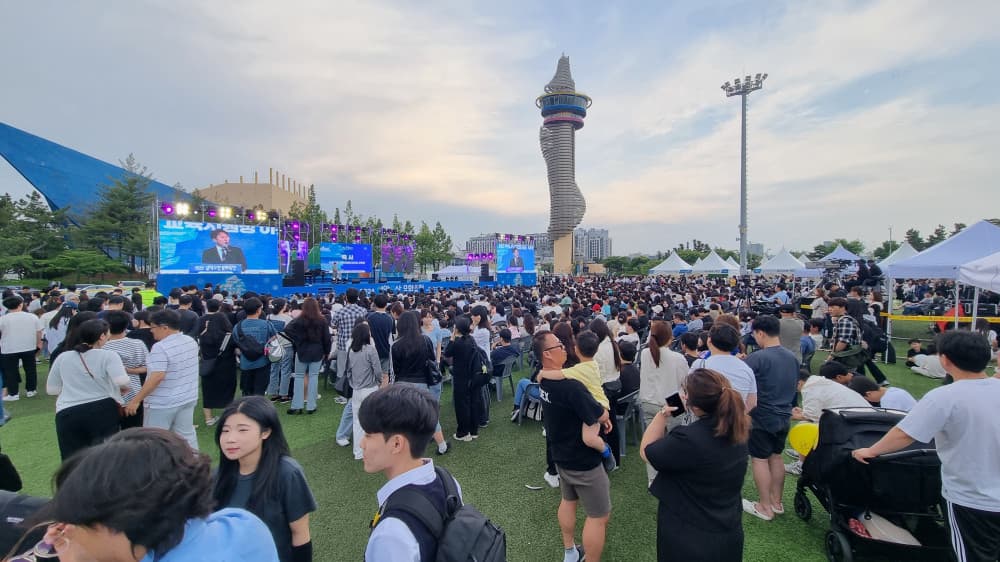
The 2026 Seorak Musan Cultural Festival was not just a weekend food fair. It was a three-part cultural weekend in Sokcho built around Musan Jo Oh-hyun, the Mt. Seorak-based Buddhist monk and poet whose name gives the festival its meaning.
This collection is now an archive for foreign visitors, editors, and future festival planners who need the 2026 event explained in plain English. It has two layers: the cultural context that explains why the weekend existed, and the official food-booth layer that turned the final vendor PDF into a usable English menu guide.
Use this page as a record, not as a live operating guide. The booth numbers, prices, and menu notes describe the May 15-17, 2026 event; future editions should be checked against the new official map before visiting.
Quick Start
| If you are... | Do this first |
|---|---|
| Researching the 2026 event | Read Festival in 3 Parts, then check What Was Confirmed in 2026. |
| Comparing the food program | Use the Food Booth Smart Map as an archive of the 26 booth layout, menu names, prices, and food context. |
| Planning a future edition | Treat the 2026 flow as a reference pattern, then verify dates, vendors, stage timing, and payment details from the new official source. |
| Trying to understand the meaning | Read Why Musan Matters before comparing festival editions. |
| Building English visitor copy | Keep Korean pronunciation in menu names, then explain spice, seafood, portion, and shareability in plain English. |
Quick Facts
| Detail | Archive note |
|---|---|
| Event | 2026 Seorak Musan Cultural Festival |
| Korean name | 2026 설악무산문화축전 |
| Dates | May 15-17, 2026 |
| Status | Ended on May 17, 2026 |
| Venue | Sokcho Expo Park Lawn / Expo Tower area |
| Best for | Culture-curious visitors, families, food travelers, May weekend visitors |
| Structure | Musan cultural program + youth festival + food culture festival |
| Booth map | Official 2026 26-booth layout and final vendor PDF checked May 13, 2026. |
| Entry | No public ticketing requirement was listed for the 2026 grounds; food and paid items were separate. |
Festival in 3 Parts
1. Seorak Musan Cultural Festival
This is the umbrella event. It frames the weekend around Musan Jo Oh-hyun's legacy and the broader ideas of harmony, coexistence, and regional culture. For visitors, this is the part that explains why the event exists at all.
In 2026, this included the main stage, public performances, opening and closing moments, and the civic-cultural atmosphere around the Expo Park lawn. This was the part to follow if visitors wanted the festival as culture, not just food.
2. Seorak Youth Culture Festival
The youth festival made the weekend feel local. The 2026 program structure includes children's drawing, children's choir, youth writing, and youth street dance events. These programs are useful for foreign visitors because they turn the lawn into a living community space instead of a tourism-only stage.
For visitors with children, this was the easiest part of the festival to explain: local and national youth participants came to Sokcho to perform, compete, and share creative work.
3. Seorak Food Culture Festival
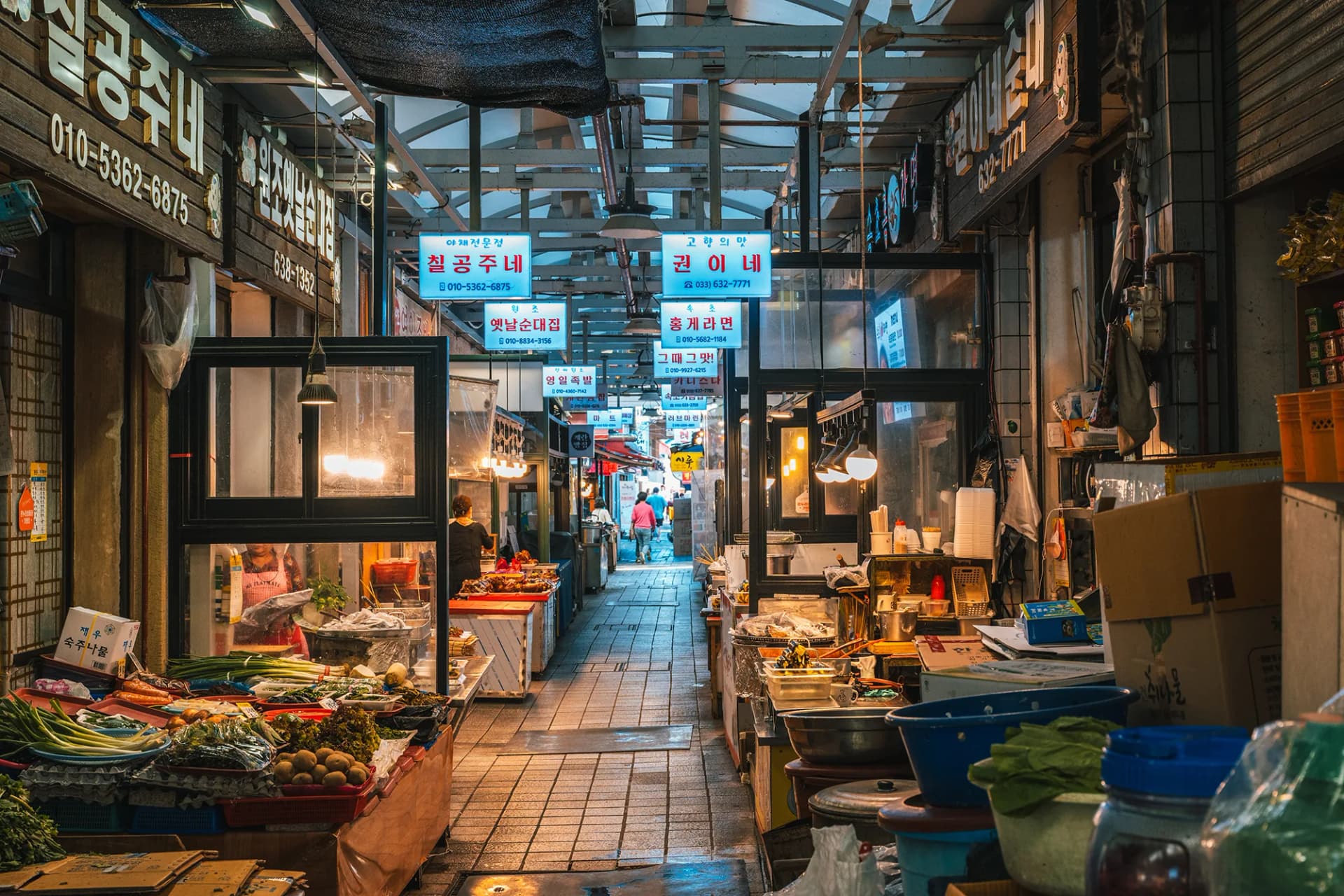
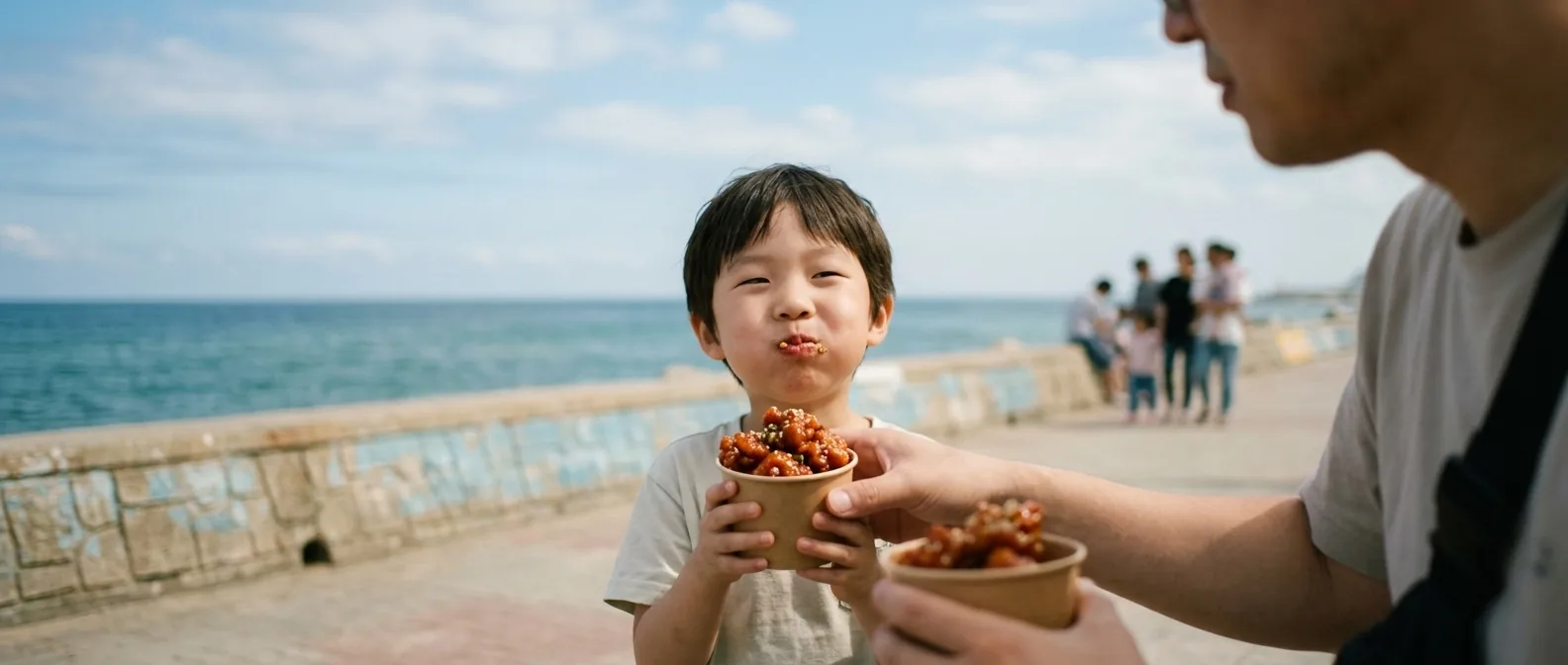
This was the easiest entry point for most foreign travelers. The food festival connected the bigger Musan weekend to Sokcho's mountain-and-sea food identity: Gangwon produce, East Sea seafood, local comfort dishes, and festival-friendly small plates.
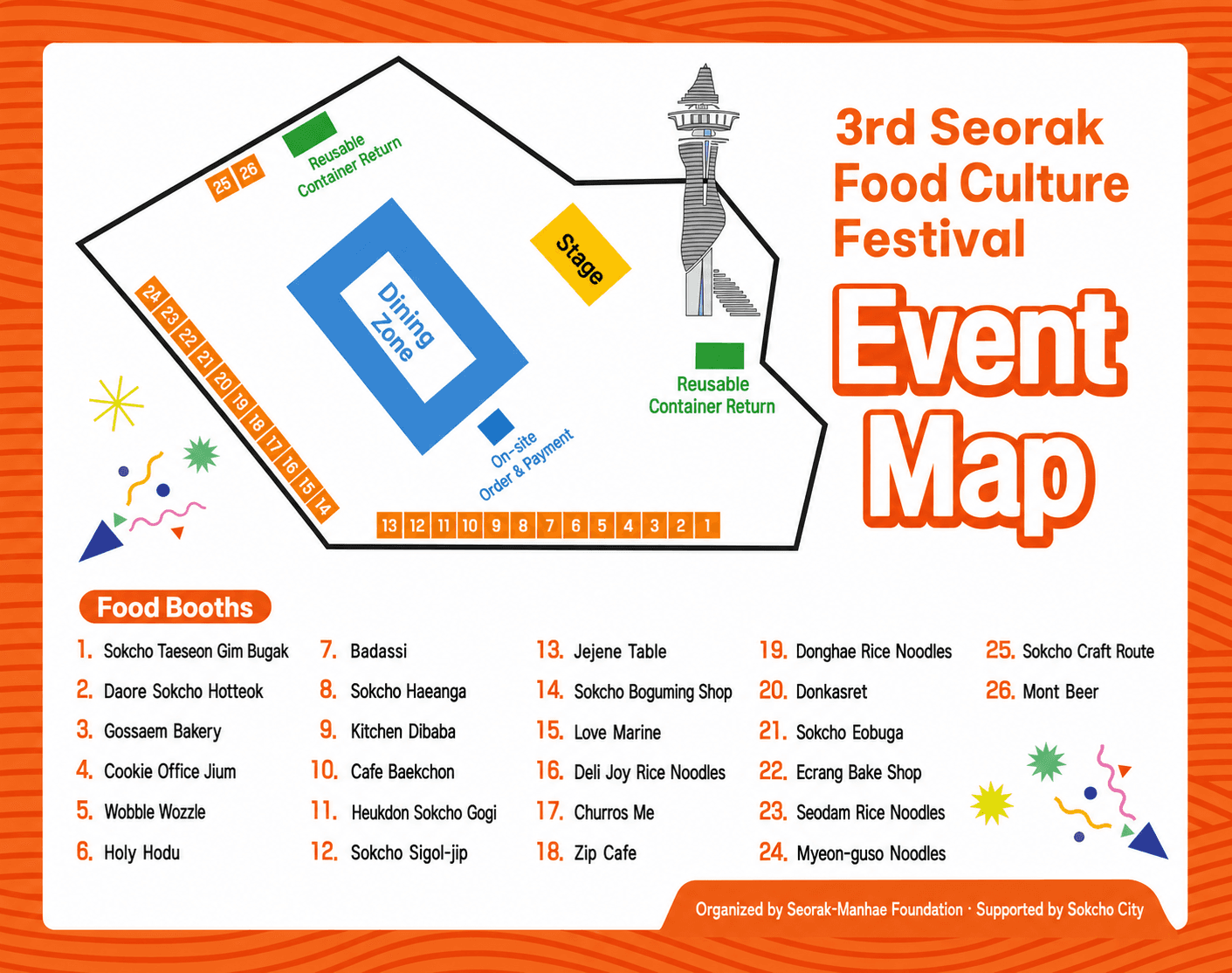
The 2026 official food layout confirmed 26 booths: meal booths, dessert and snack
booths, coffee, craft beer, and two reusable-container return points around
the central dining zone. The useful English layer was not just a direct
translation. A foreign visitor needs to know what Hongge Ramyeon,
Memil Jeonbyeong, Gim Bugak, or Myeongnan Hotteok would feel like before
standing in a queue.
That is why the smart map below keeps Korean pronunciation in the menu names and uses the description field to explain the dish context: seafood risk, spice level, whether it is a snack or a full meal, and whether it works as a shareable order.
How to Use the Festival Ground
The 2026 event was easiest to understand from the Expo Park lawn, not from a single booth or performance. The site worked as a set of zones:
| Zone | Visitor job |
|---|---|
| Main stage | Check what was happening and what started next. |
| Youth program area | Watch the community side of the festival and avoid reducing the event to food only. |
| Food zone | Walk once before ordering. Compare dishes visually. |
| Cheongcho Lake edge | Use it as a crowd break, child reset, or post-meal walk. |
| Beach add-on | Save for the end, not the middle of the festival visit. |
Food Zone Strategy
Even with the final 2026 booth list confirmed, the best food UX was still category-first, not booth-first. Foreign visitors did not need 26 booth names at the top of the page. They needed to know what kind of food they were looking at, then use the booth number to find it on the ground.
Food Booth Smart Map
Food smart map
26 booths, pronunciation-first English menus.
Official layout plus final vendor PDF checked on 2026-05-14. 175 menu entries are translated with Korean pronunciation first.
Menu names and prices cross-checked against the official musanfesta.com booth listings on May 14, 2026. English names use pronunciation-first Korean food wording, with plain-English context in the descriptions.
Booth selector
Booth menus.
Use the menu descriptions as archive context, not as current restaurant-style tasting notes. Festival decisions were practical: was it spicy, seafood-heavy, child-friendly, shareable, cold, alcoholic, or a full meal?
| Category | What visitors need first |
|---|---|
| Korean / Gangwon dishes | English dish name, main ingredient, spicy level, rice/noodle/soup cue |
| Seafood | Raw/cooked distinction, shellfish warning, price range, waiting time |
| Noodles and street food | Portion size, kid-friendliness, whether it works as a snack |
| Fusion or international | What makes it local enough to belong in this festival |
| Drinks and dessert | Caffeine, alcohol, cold options, child-safe choices |
The map prioritizes these actions:
- Filter by food category before booth number.
- Show translated dish names and Korean names together.
- Keep Korean pronunciation in the English menu name where possible.
- Add allergy and shellfish warnings where obvious.
- Show "good first order" recommendations for visitors who do not know Korean food.
- Keep a simple non-map list underneath for weak mobile connections.
What to Eat First
The 2026 food strategy worked best in this order:
- Choose one safe starter that you can eat while walking.
- Choose one local dish that explains Sokcho or Gangwon.
- Choose one shareable dish if you are in a group.
- Stop before you are full, then watch a stage or youth program.
For foreigners, the best festival-food copy should avoid vague words like "traditional" unless the dish is explained. "Buckwheat noodles from Gangwon" is better than "traditional noodles." "Squid stuffed with sundae filling" is better than "local sundae."
2026 Visitor Patterns
| Time available | Best 2026 flow |
|---|---|
| 60-90 minutes | Main lawn orientation, food zone walk-through, one dish, short lake break |
| 2-3 hours | Youth program or stage moment, two food stops, Cheongcho Lake edge |
| Evening visit | Food first, main stage second, Sokcho Beach or lake walk last |
| Family visit | Youth program, one easy dish, restroom/checkpoint break, short second loop |
| Culture-first visit | Background section before arrival, main stage, youth program, food as supporting context |
Why Musan Matters
The official foundation describes the festival as a cultural event that commemorates the harmony and coexistence associated with Musan Jo Oh-hyun, who was active around Mt. Seorak. That line matters because it changes the way a visitor should read this weekend.
Musan is not a decorative name. It points to a real cultural lineage around Mt. Seorak, Korean Buddhist literature, poetry, and civic cultural work. The foundation behind the festival, Seorak-Manhae Thought Practice Promotion Foundation, explains its purpose as honoring and promoting the spirit of both Manhae Han Yong-un and Musan Jo Oh-hyun.
For a foreign visitor, the simplest reading was this: the festival turned a local spiritual and literary legacy into a public civic weekend. The food zone and youth programs were not separate from that purpose. They were how the festival turned "harmony" and "coexistence" into something visible on the lawn.
How the Festival Grew
The background is short enough to understand before comparing festival years:
| Year | Why it matters |
|---|---|
| 1996 | The Manhae Thought Practice Promotion Foundation was organized to promote Manhae Han Yong-un's ideas of freedom, equality, and peace. |
| 2018 | Musan Jo Oh-hyun died at Sinheungsa in Sokcho. |
| 2021 | The organization was renamed Seorak-Manhae Thought Practice Promotion Foundation. |
| 2023 | The first Seorak Musan Cultural Festival was held, centered on the youth festival format. |
| 2024 | The second festival expanded around Cheongcho Lake and the Expo Plaza area. |
| 2025 | The festival continued as a broader cultural weekend with food, youth programs, and performances. |
| 2026 | The festival returned to the Sokcho Expo Park lawn from May 15-17, with food and youth programming central to the visitor experience. |
What Was Confirmed in 2026
| Status | Details |
|---|---|
| Confirmed for 2026 | Dates, Expo Park venue, the three-part festival structure, youth program categories, main Musan frame, official 26-booth food layout, final vendor menu PDF |
| Useful pattern | Main lawn as the visitor center of gravity, food culture festival as the easiest foreigner entry point, reusable-container return points around the food zone |
| Not reusable without checking | Per-booth sellouts, temporary pauses, queue pressure, card/cash behavior, exact last orders |
| Must be rechecked for future editions | Weather plan, stage timing, parking pressure, table availability, reusable-container return flow |
This page stays live as an archive because the most important UX lesson is not just finding a booth pin. Foreigners need the event explained first, then they need Korean menu names turned into practical ordering context.
Practical FAQ
Do I need Korean?
No, but you will have a better time with a few phrases. Save "eolma-ye-yo?" (How much?), "igeo juseyo" (This one, please), and "eodi-ye-yo?" (Where is it?). For more, use Korean Phrases for Sokcho.
Should I bring cash?
For the 2026 event, cash was a sensible backup. Even when many booths accept cards, a festival setting is the wrong place to rely on one payment method. For future editions, check the organizer's latest payment notes and still bring small-bill backup.
Is it worth going if I only care about food?
The 2026 food zone was worth understanding, but it was part of a larger cultural weekend, not a standalone night market. The stronger visitor pattern was to walk the stage and youth areas once so the visit felt like Sokcho, not just another snack stop.
Is it family-friendly?
The 2026 setup was family-friendly because the youth festival was built into the event. The main practical issue was crowd management: one meeting point and the lake edge as a reset area.
Should I wait for a future booth map before planning?
Yes. Use this 2026 smart map to understand the format, but wait for the next official booth map before making current ordering plans. Vendors, prices, layout, and last-order behavior can all change.
Pair It With the Rest of Sokcho
If a future festival brings you to Sokcho from outside the city, keep the surrounding plan simple:
- Use Getting to Sokcho from Seoul if it is a weekend trip.
- Use Sokcho Without a Car if you are relying on buses and taxis.
- Use 10 Must-Try Dishes in Sokcho if a festival food zone makes you want a second meal elsewhere.
- Use Half-Day in Sokcho if you want to combine the festival with the market and Abai Village on another day.
Sources and Update Notes
This archive separates confirmed 2026 context from operating details that cannot be reused blindly. The festival background is based on the Seorak-Manhae Foundation's official introduction and festival pages, which explain the foundation's purpose, the Musan/Manhae lineage, and the festival's civic-cultural frame. The 2026 operating layer was checked against the official Musan Festa site, the official event-map image, and the final vendor menu PDF provided on May 13, 2026.
- 2026 Musan Festa official site
- Seorak-Manhae Foundation introduction
- Seorak Musan Cultural Festival background
Reviewed by HeySeorak on July 2, 2026 after the event ended. The next content update should happen when the organizer announces a future edition or publishes a new map, schedule, or booth list.