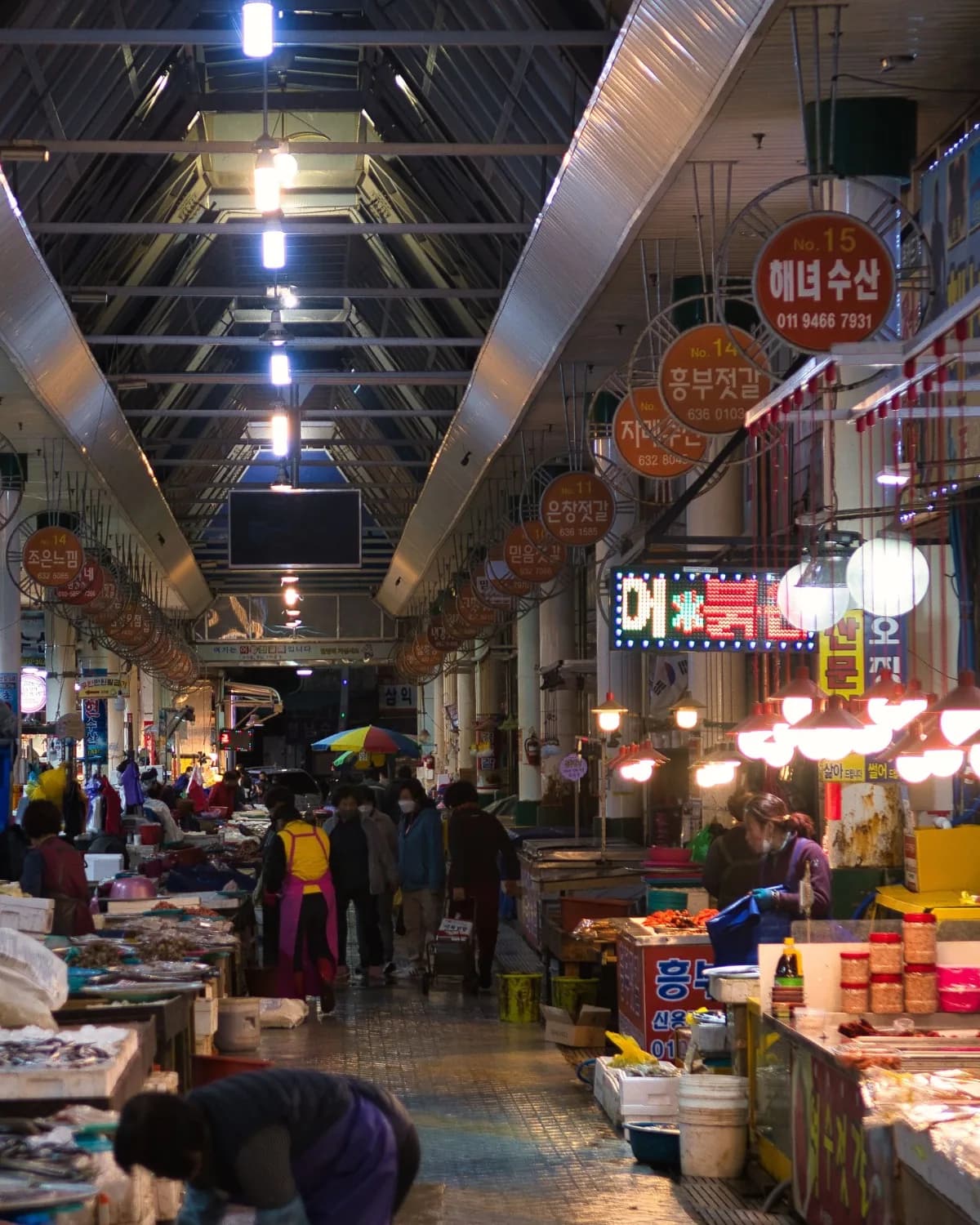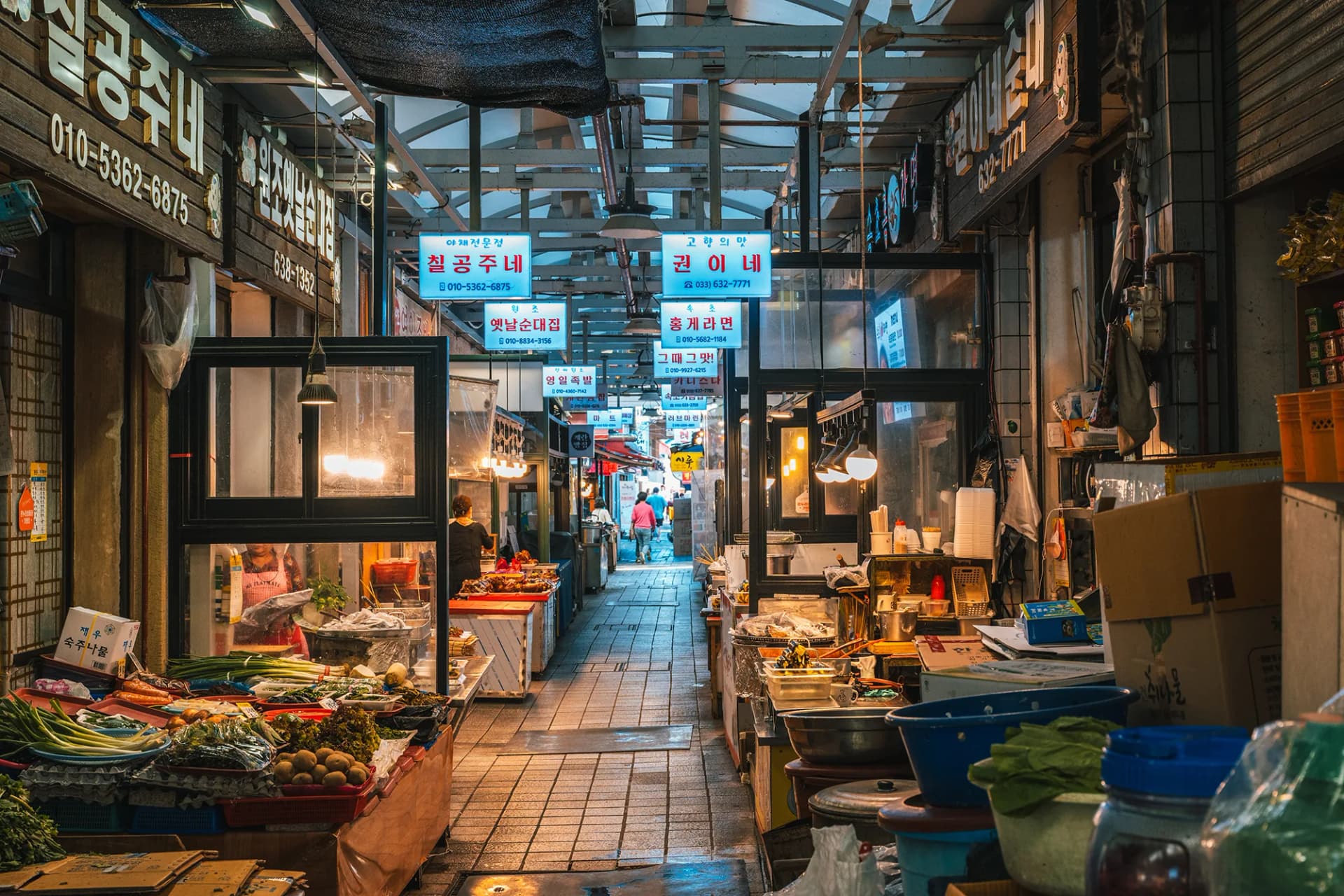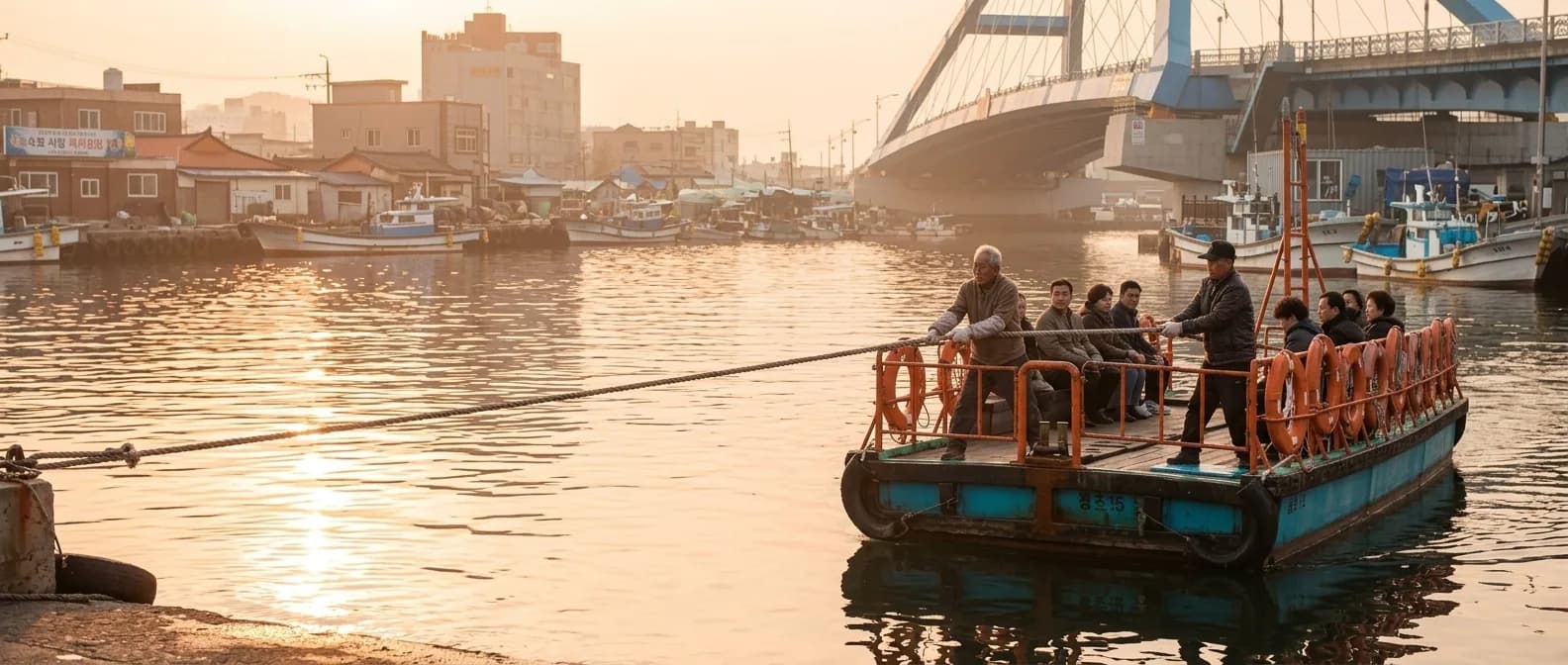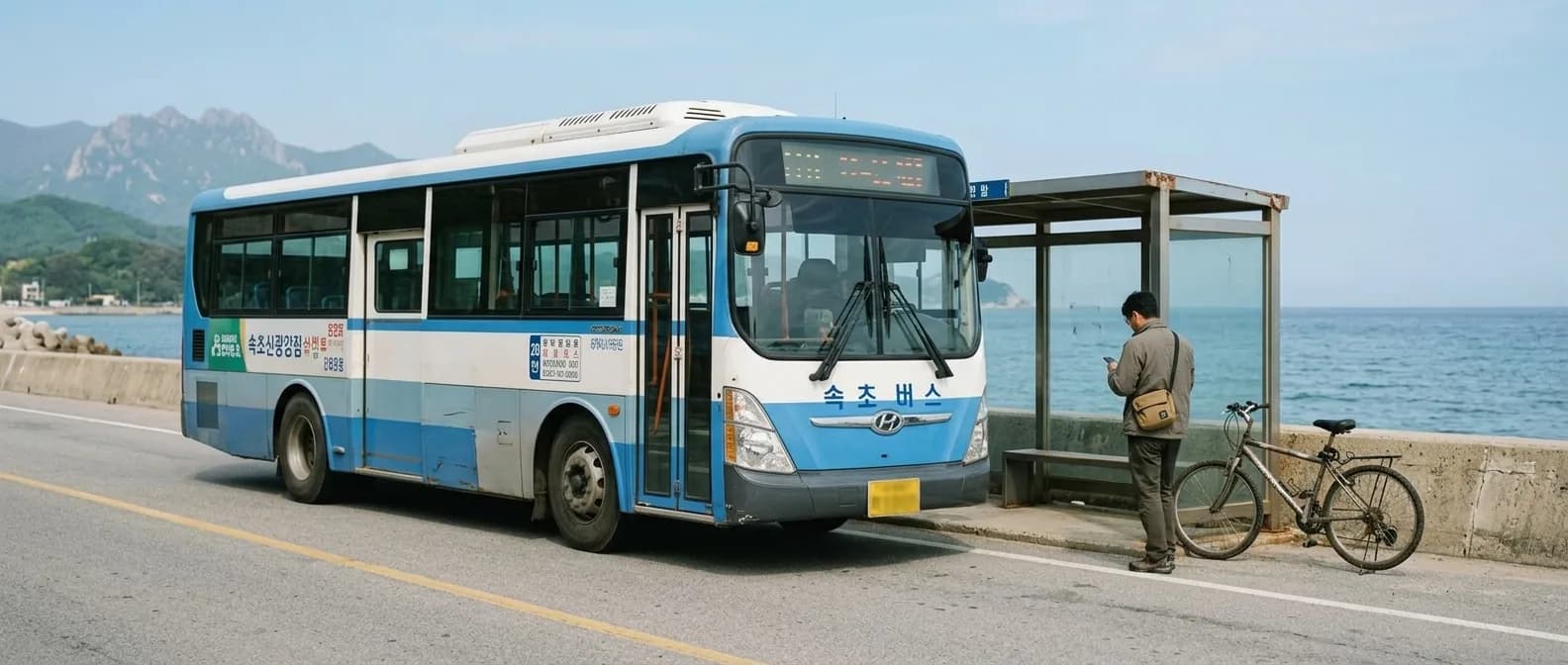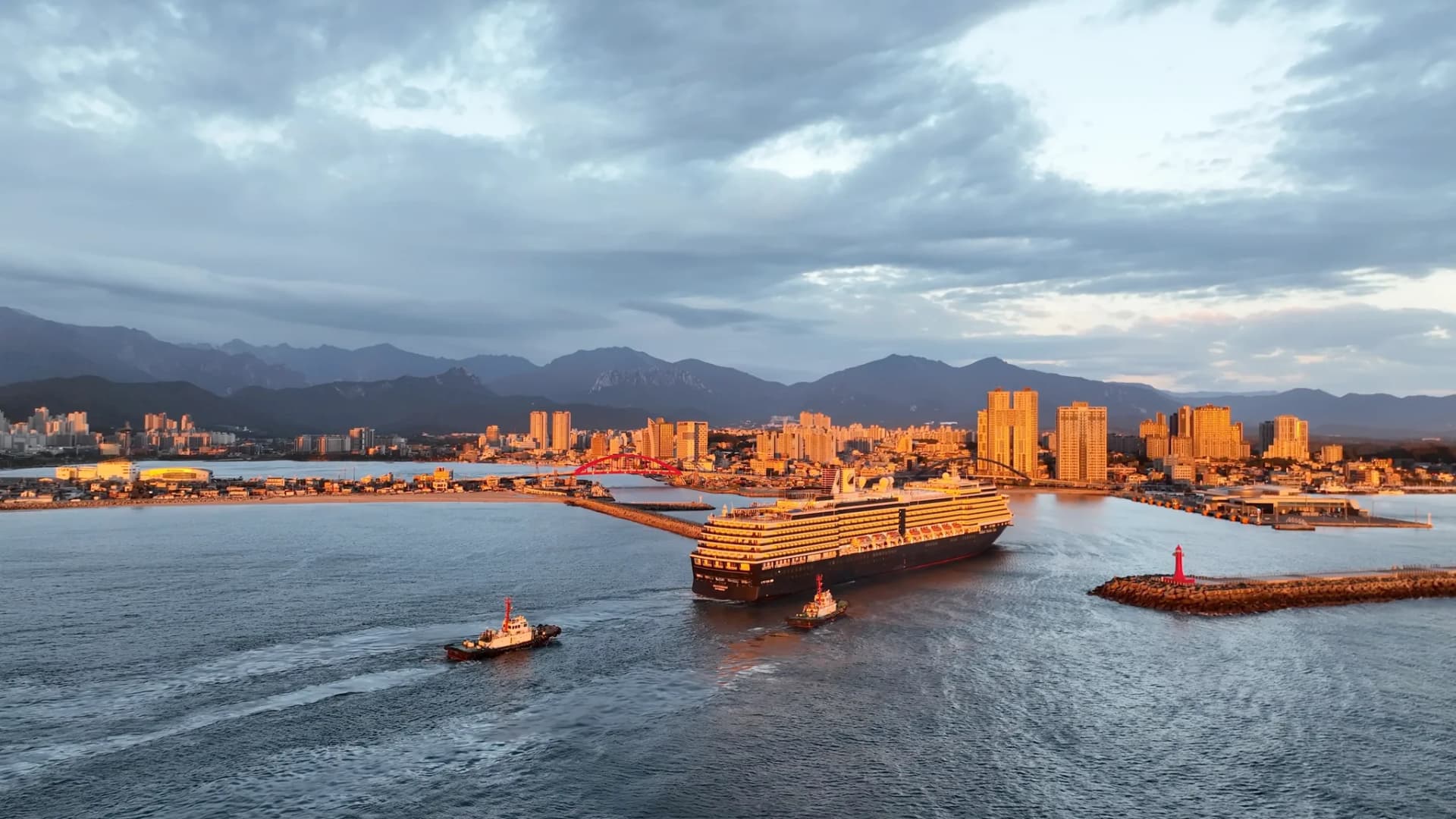
This is the Sokcho cruise port walking route that most independent passengers want and few find on their own: out of the terminal gate, through the lanes of Abai Village, across the channel on the hand-pulled Gaetbae ferry, and into Sokcho Tourist & Fishery Market for the food the city is known for. It is about one kilometre of flat walking plus a four-minute ferry ride, and it answers the question of what to do in Sokcho from the cruise terminal without a tour bus, a taxi, or much Korean.
We walked it on 4 September 2026 with a GPS track running, so the distances, street names and the restroom and Wi-Fi points below are from that walk and from Sokcho City's September 2026 facility inventory, not from a map guess.
Route at a glance
| Distance | 1.0 km walked, plus the Gaetbae crossing (walked 2026-09-04) |
| Walking time | ~15 min on foot, ~4 min on the ferry |
| Plan for | 90 min with a snack and a look around; 2 h with lunch |
| Terrain | Flat. Paved lanes and streets, a few kerbs, no stairs |
| Start | Sokcho Cruise Terminal gate (속초항 국제크루즈터미널) |
| Finish | Entrance of Sokcho Tourist & Fishery Market (속초관광수산시장) |
| Return | Free call-day shuttle from opposite the market parking lot, taxi, or walk back the same way |
| Restrooms | Gaetbae Abai-side dock (basic), Cheongho Beach, old breakwater, market B1 and 2F |
| Wi-Fi | Terminal hall, Gaetbae ferry office, Abai Village main street, market B1 |
The line on the walking map is the actual track. Open it once while you still have the ship's Wi-Fi or the terminal's, and it keeps working without signal, restrooms and Wi-Fi pins included.
Sokcho cruise port walking route, turn by turn
Street names are given in English first with the Korean sign in parentheses, because the signs you will see are Korean.
- Terminal gate, 0 m. Walk out of the terminal hall and turn left along the quay, keeping the ship behind you and the water on your left. The call-day taxi stand, the temporary exchange booth and the shuttle pickup banner are all in the parking lot here. Look for them now so you know the return picture.
- South along the terminal quay, 0 to 400 m. This is port road, wide and flat, with the Coast Guard substation on the way (a restroom inside during its opening hours). The road bends right and the first houses of Abai Village appear.
- Abaimaeul 1-gil (아바이마을1길), 400 m. Turn into the first village lane. The scale changes at once: low houses, drying racks, narrow footpaths. A short side step to the left reaches Cheongho Beach, the village's sea-facing edge, with public toilets by the beach and at the old breakwater.
- Abaimaeul-gil (아바이마을길), 520 m. The lane joins the village main street. Follow it south. Free public Wi-Fi covers this stretch, and the sundae-soup restaurants that made the village famous are on both sides.
- Gaetbae dock, Abai side (갯배 승강장, 아바이마을), 640 to 765 m. The main street ends at the water. Pay at the kiosk or the window, walk onto the flat ferry, and cross. The ferry office next to the dock has free Wi-Fi and a basic toilet.
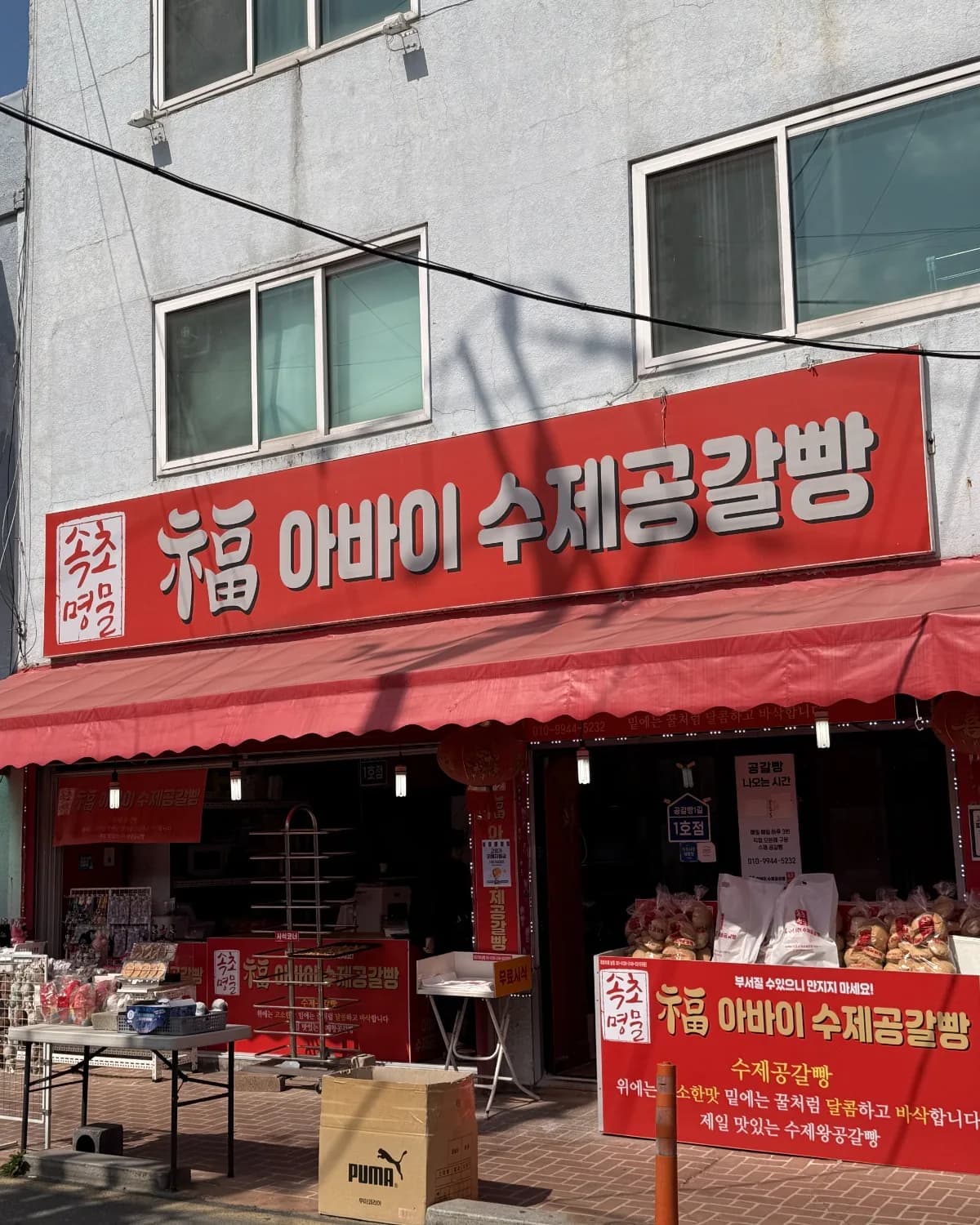
- Gaetbae dock, downtown side (갯배 승강장, 중앙동). You land on Jungangbudu-gil (중앙부두길) with cafes, a GS25 and the gonggal-ppang bakery within a minute. Walk north-west, away from the water.
- Cheongchohoban-ro (청초호반로) and Jungang-ro (중앙로), 885 to 900 m. Cross at the market-entrance junction (중앙시장입구삼거리); the bus stops here are named "Gaetbae Entrance" (갯배입구) and "Tourist & Fishery Market" (관광수산시장), which tells you where you are. A Shinhan Bank branch with ATMs is on the corner.
- Jungangsijang-ro (중앙시장로), 950 m. The market street. Packaged jeotgal shops start here, the chicken alley is one block on, and the market's main building with its basement fishery hall is straight ahead.
- Sokcho Tourist & Fishery Market entrance, 1,045 m. Finish. The shuttle stop back to the ship is across from the main parking lot, at the village-bus stop.
That is the whole route. There is one decision in it, which is whether to take the beach side step in Abai Village, and one queue, which is the ferry.
What fits your shore window
Ships calling at Sokcho have given passengers anything from a tight half-day to a full day ashore. Work backwards from all-aboard and treat the terminal gate as the clock.
Two hours ashore. Walk straight through Abai Village without the beach detour (15 minutes), cross on the Gaetbae (10 minutes including the wait), pick one thing at the market and eat it standing up or on the shuttle (30 minutes), then take the shuttle or a taxi back (15 minutes door to door on recent calls). You have roughly 45 minutes of slack. Use it at the market, not in the village, because the return leg starts from the market.
Four hours ashore. Everything above plus a sit-down meal: sundae soup or stuffed squid in Abai Village on the way, or the crab lunchbox at the market at the end. Add the beach side step and a coffee at the downtown dock. You will still be back with an hour in hand, which is the right buffer for a ship that boards a few thousand people through one gangway.
Longer than four hours. Do this route first, then decide. The Half-Day in Sokcho plan continues from the market into the city, and the Sokcho Harbor & Lighthouse Walk starts from the same terminal gate in the other direction. Seoraksan is a separate day; on a cruise call it costs you the mountain traffic, the cable car queue and the long return, and any of the three can eat your buffer.
Abai Village, the walk before the ferry
Abai Village (아바이마을) began as a settlement of refugees from North Korea's Hamgyeong provinces who stopped here in the 1950s expecting to go home soon. "Abai" is the Hamgyeong word for father or old man. The food they brought is still the reason to slow down here: Abai sundae, a blood sausage stuffed with rice and vegetables, and stuffed squid, both served with a rich soup.
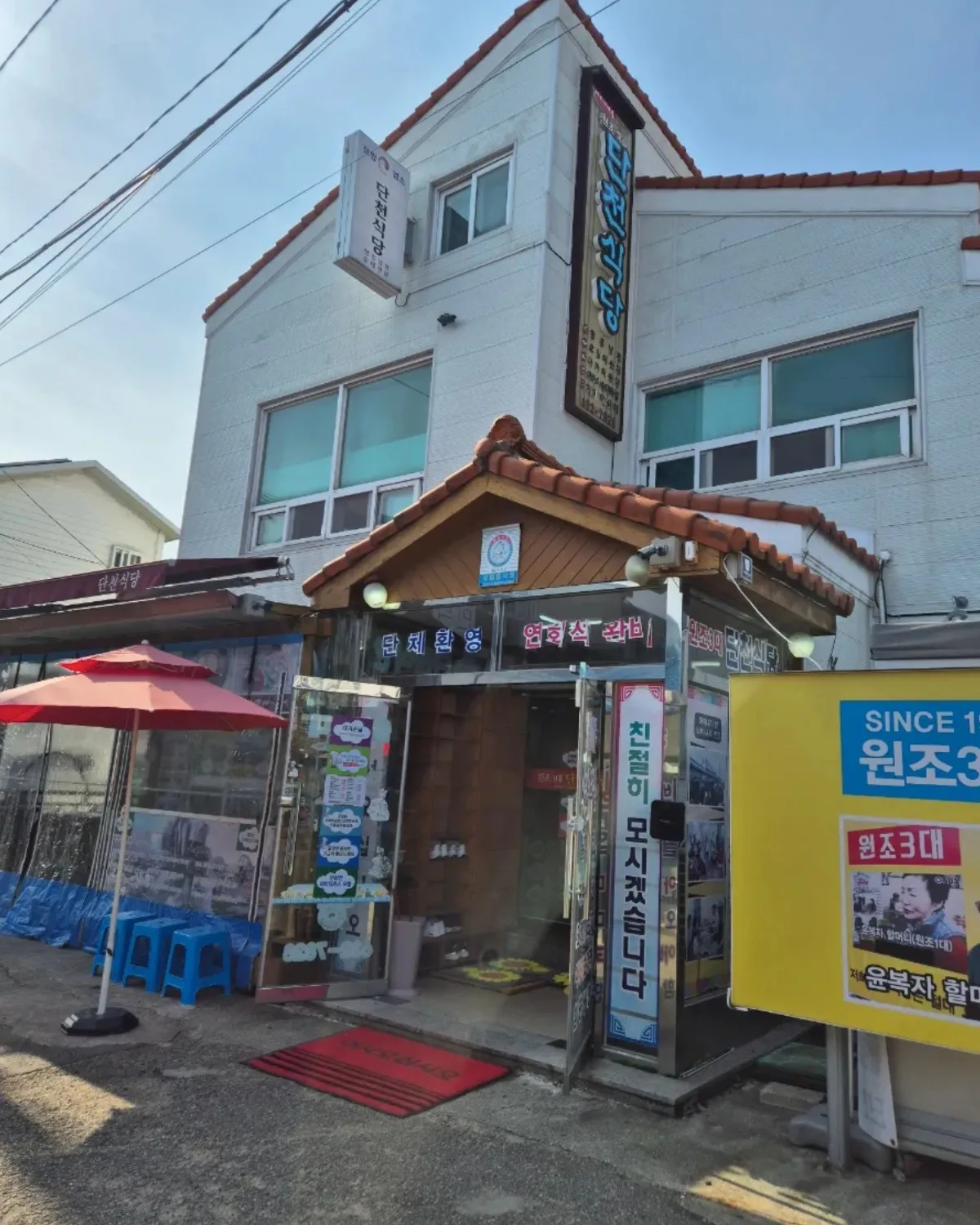
Dancheon Sikdang sits on the main street and has an English menu; a combination plate of stuffed squid and sundae with a bowl of soup is the order to share. If it is full, Bukcheong Traditional Abai Sundae 2nd Generation is a few doors along with the same dishes. Neither is fast food. Give a sit-down meal here 40 minutes and only do it on a four-hour window or longer.
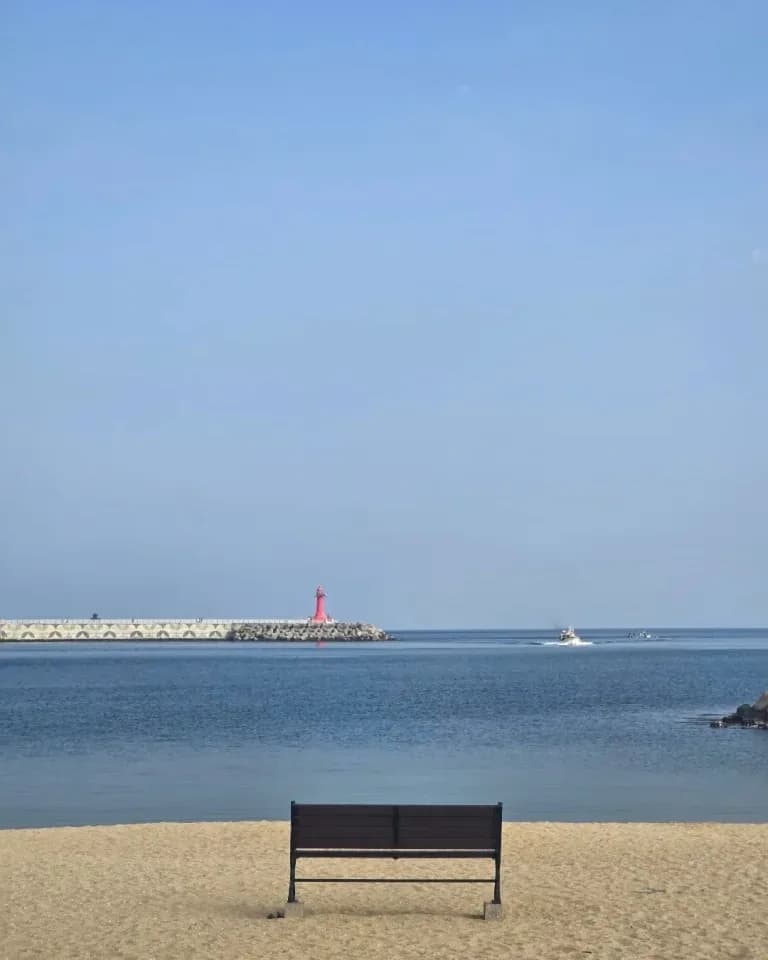
Cheongho Beach is the optional side step off the first lane. It is small and often empty, and it is the only place on this route where you stand facing the open East Sea. On a short window skip it; on a long one it is worth five minutes.
The Gaetbae ferry crossing
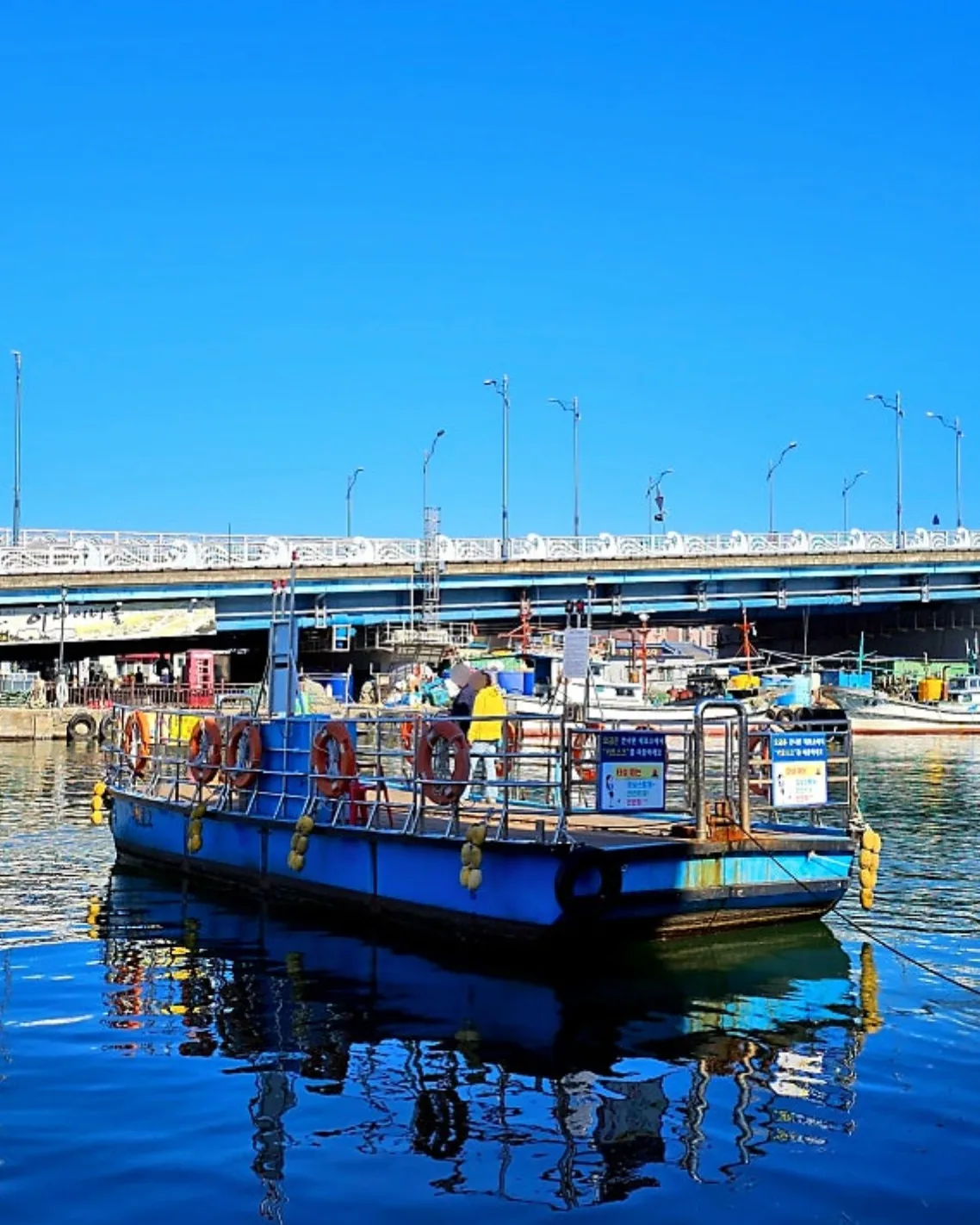
The Gaetbae is a flat, open barge that runs on a cable across the channel between Abai Village and downtown. Passengers pull it by hand with iron hooks, and the crew will hand you a hook if you look willing. The crossing takes about four minutes. It runs every few minutes when people are waiting and does not have a timetable.
Fares are collected on the Abai side only, at a card kiosk or in cash. Adults pay 500 KRW, children 300 KRW. So on this route you pay before you board; if you return the same way you board downtown and pay when you land. Hours are roughly 05:00 to 23:00 from May to October and 05:30 to 22:30 from November to April, and the ferry can stop in rough weather. On a call day the queue at the Abai dock can be 10 to 15 minutes when a few hundred passengers arrive at once; the walk itself takes long enough that the crowd thins if you leave the ship a little after the first rush.
If you would rather not queue, or the sea is up, the free shuttle from the terminal goes round by road to the market and skips the crossing entirely.
Eating at the market
Sokcho Tourist & Fishery Market (속초관광수산시장) is the market many visitors still call Jungang or Central Market; the name changed, the market did not. The full food guide is on the market page. For a cruise call, three stops cover it.
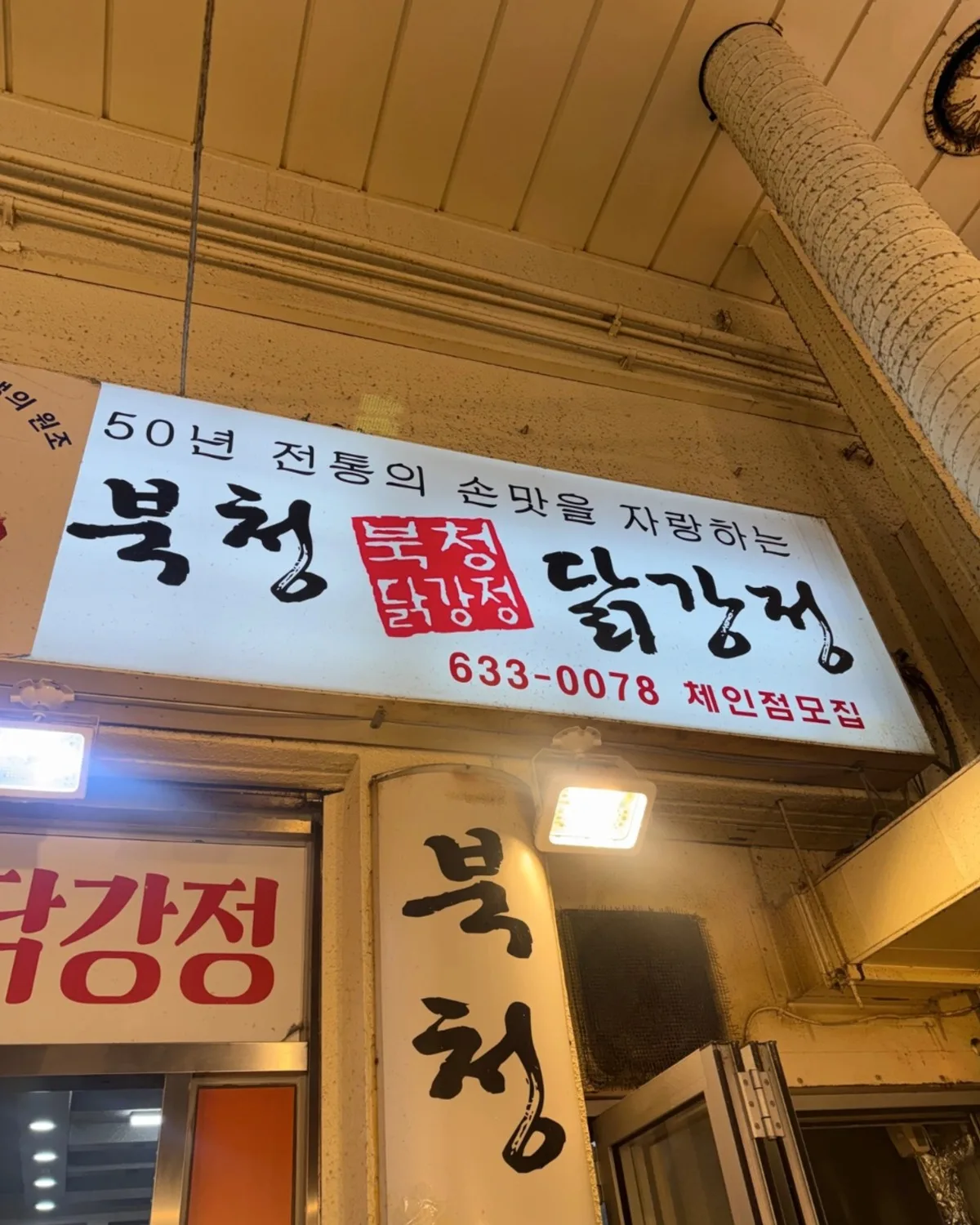
Dakgangjeong (닭강정). Sokcho's version of fried chicken: bite-size pieces in a sticky sweet-and-spicy glaze, sold by the box and eaten at room temperature, which makes it the ideal thing to carry back on board. Bukcheong Dakgangjeong, Jungang Dakgangjeong and the market branch of Manseok Dakgangjeong stand within a few metres of each other in the chicken alley. Any of the three is a correct answer. Ask for the small box and for 순한맛 (mild) if spice is a concern.
Red snow crab (홍게). The market's signature — see the two tastes below for where to have it without a fight with the shell.
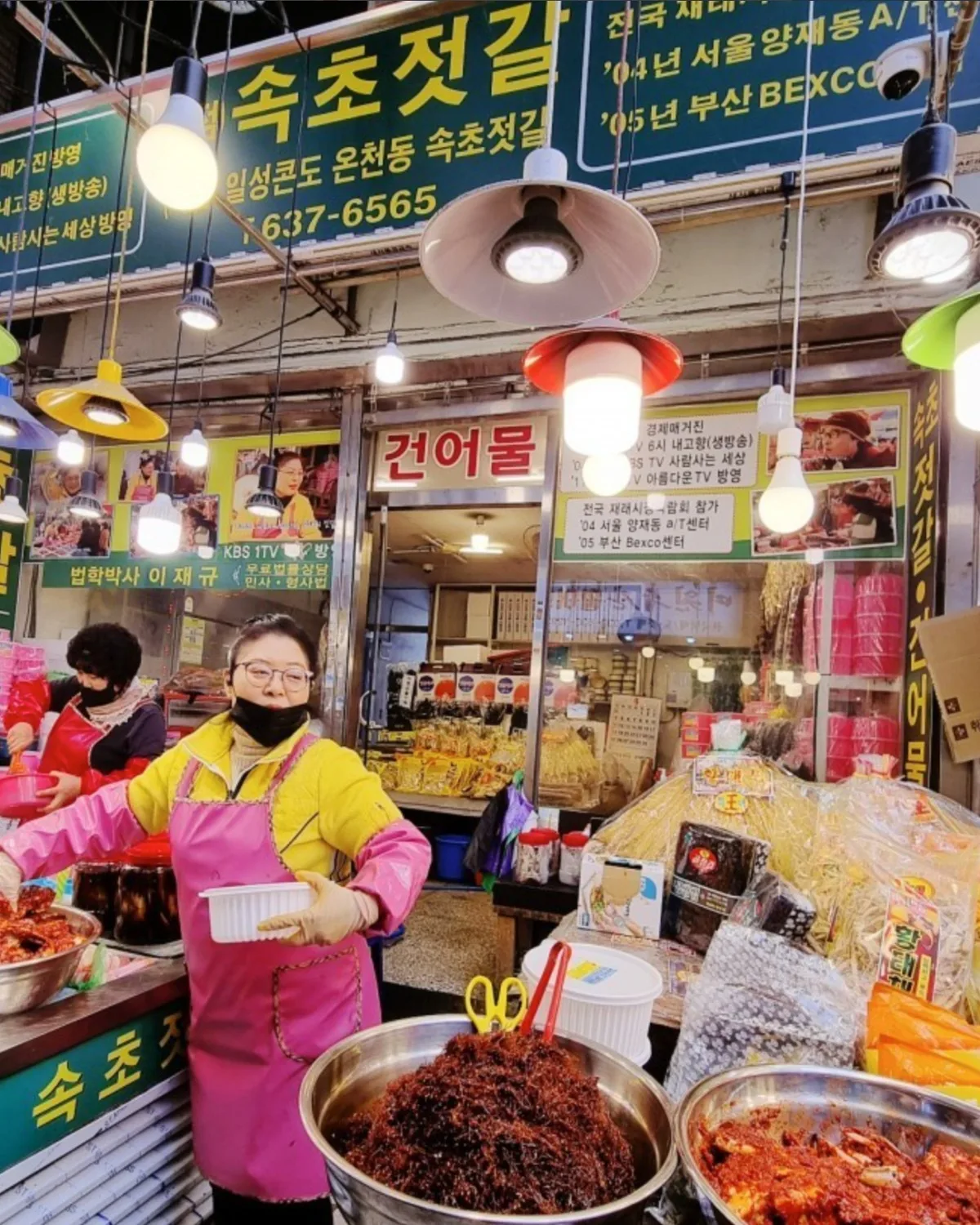
Jeotgal (젓갈). Salted and fermented seafood, the Hamgyeong refugees' other gift to the city. Sokcho Jeotgal and Seongsil Sikhae Jeotgal sell vacuum-packed jars that survive a day in a bag. Gajami sikhae, fermented flounder with millet and chili, is the local specialty; pollock-roe jeotgal is the easier one to like.
Two tastes worth the whole walk
If you only do two things inside the market, do these two. Both are HeySeorak spots with English menus, both sit inside the market hall, and together they take about forty minutes.
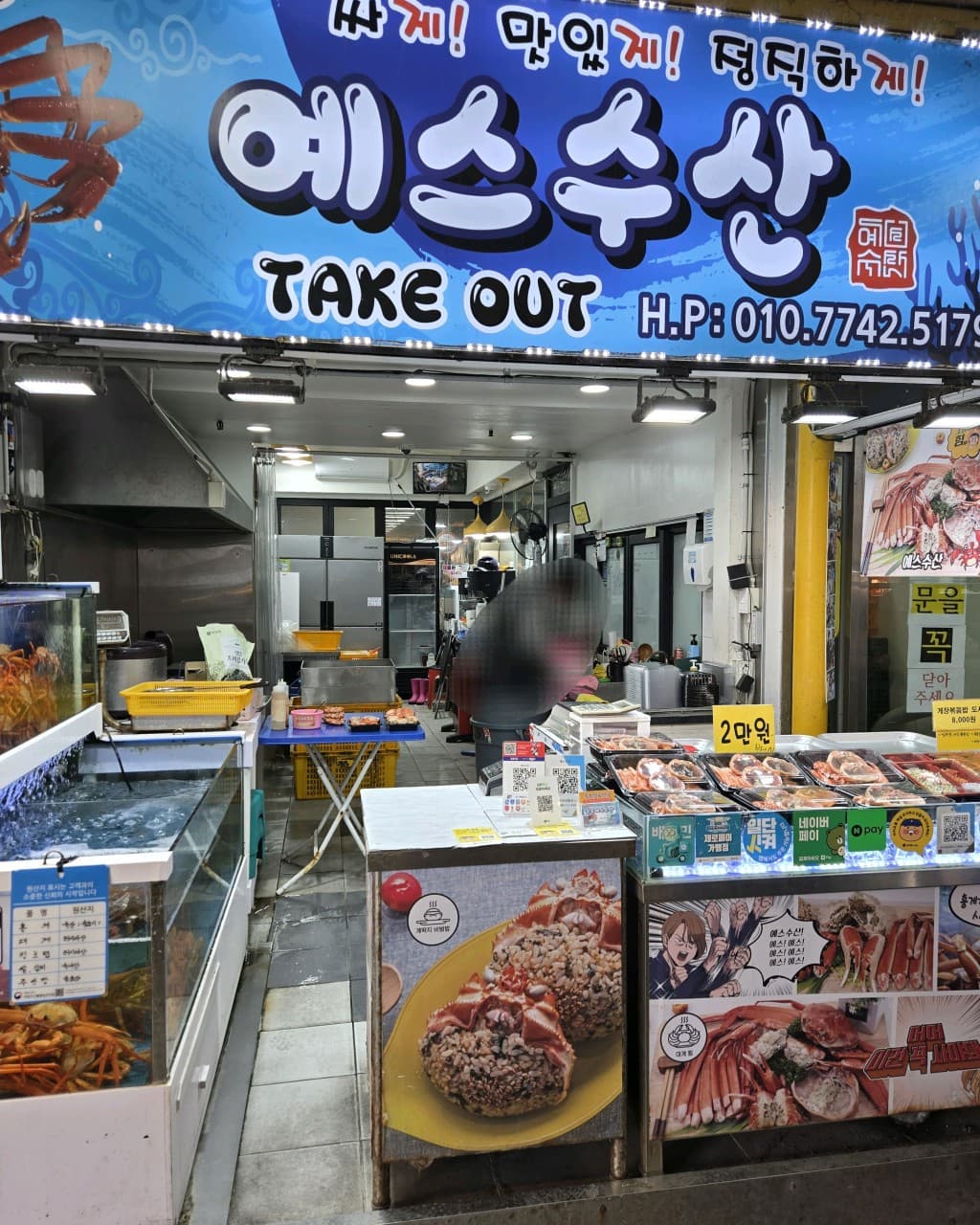
Red snow crab lunchbox at Yes Su-san (예스수산 홍게도시락). Yes Su-san is a crab specialist that invented this format for exactly your situation. A whole red snow crab (홍게) is steamed, cracked and packed into a box with gloves and chopsticks, so you eat the meat in minutes instead of fighting the shell for an hour. The crab is fresh off Sokcho boats — the owner buys from crews that stay out three to four days for a better catch and uses only crabs with a high meat yield, which is why the box tastes of crab rather than of shell water. Ask how long the wait is when you order — live crabs take time to steam — and take the pre-steamed pickup version if your window is tight. Prices move with the catch, so read the board on the day. Closed on Tuesdays.
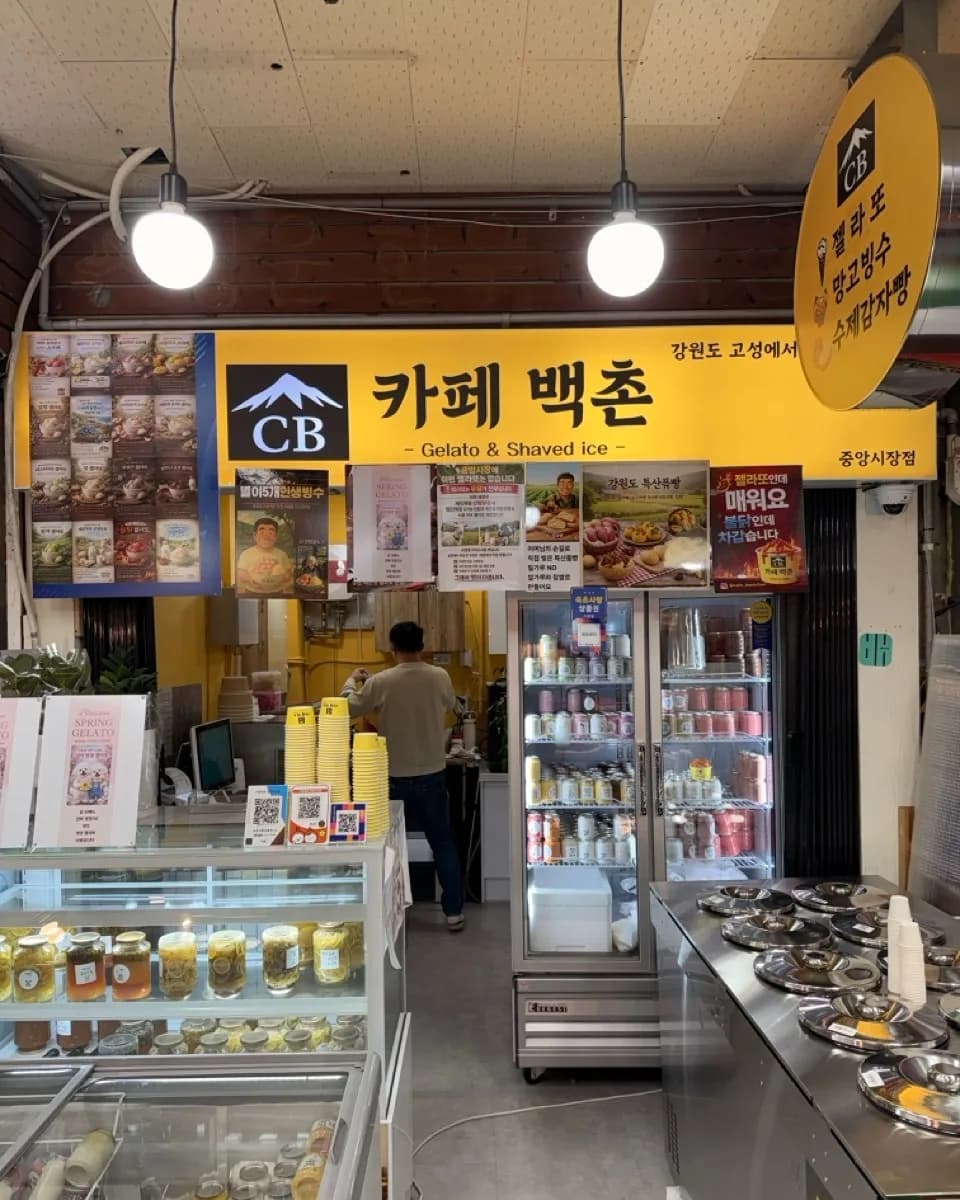
Organic gelato at Cafe Baekchon (카페백촌 유기농 젤라또). Cafe Baekchon is the market's gelato counter: small batches made from organic ingredients and whatever fruit is in season, with sorbets and a fruit bingsu alongside, and nothing artificial in any of them. A cup after the crab is how this walk should end — it is cold, it is quick, and it is the one dessert in the market that was not fried. It sits inside the hall, so you can eat it under cover if the weather has turned.
Two smaller stops if you still have minutes to spare: TMM Market, a shop selling keychains cut from sea glass and other things made in Sokcho, for a souvenir that is not a fridge magnet, and Sokcho Octopus Rice Soup across from the market as the sit-down alternative if crab is not your thing.
Most market stalls open through the day, with the food alleys busiest from late morning to early evening; the official listing gives 08:00 to 24:00 with hours varying by store, and the fried-chicken and snack stalls tend to wind down in the evening. A morning or lunchtime call lands in the best window.
Restrooms, Wi-Fi and money along the way
Sokcho City published a facility inventory for the cruise season in September 2026, and these are the points on or within a minute of the route. They are all pinned on the HeySeorak map, which loads once and then works offline.
- Cruise terminal (속초항 국제 크루즈 터미널). Free public Wi-Fi inside the hall. Temporary exchange booth and staffed taxi stand on call days.
- Coast Guard substation (속초해양경찰서 파출소). Restroom inside a public building, during its opening hours only.
- Gaetbae dock, Abai side (청호 갯배). Basic toilet, no flush. The ferry office next door (속초항갯배) has free public Wi-Fi.
- Cheongho Beach (청호동 해변) and the old breakwater (청호동 (구)방파제). Public toilets, a short side step off the first lane.
- Abai Village main street (아바이마을). Free public Wi-Fi by the sundae-soup restaurants.
- Sokcho Tourist & Fishery Market (속초관광수산시장). Restrooms in the basement and on the second floor of blocks A and C, open during business hours. Free public Wi-Fi in the basement. Bank ATMs on the main street take global cards.
Cards work on the Gaetbae kiosk, in every Sokcho taxi and at most market counters. Some stalls in the alleys still prefer cash for small amounts, so a little won helps.
Getting back to the ship
On recent calls the city ran a free shuttle between the terminal parking lot and the stop opposite the market's main parking lot, roughly every 30 minutes, with English-speaking staff at both ends and a last bus back around 18:30. A banner marks the pickup at the terminal. Times and the last-bus hour change per call, so read the board at the terminal in the morning, or check the call-day page, and do not plan around the last bus.
Taxis are the fallback and the fast option: every taxi in Sokcho takes cards, the ride from the market to the terminal is a few minutes by road, and there is a staffed taxi stand at the terminal gate on call days. Show the driver the words 크루즈터미널 (cruise terminal) on your phone. Walking back the way you came works too and takes the same 20 minutes plus the ferry, with the fare this time paid when you land.
Whatever you choose, be at the market shuttle stop or in a taxi 60 minutes before all-aboard, more if your ship boards through a single gangway. Sokcho is an easy port to return to; the only way to miss the ship here is to assume the last shuttle will wait.
If the weather turns
The Gaetbae stops when swells or wind pick up, and the market alleys are roofed but open at the ends. If the forecast is poor, take the shuttle straight to the market, eat under cover, and switch the rest of the day to the Rainy Day in Sokcho plan. The market basement, the fishery hall and the dakgangjeong alley all work in rain.
Keep walking
With the market done and time to spare, the Sokcho Harbor & Lighthouse Walk leaves from the same terminal gate in the opposite direction, and the Abai Stories collection goes deeper into the village you just walked through. For the practical layer of a call day, including the shuttle and the current call schedule, use the cruise page. If English menus are a worry, the list of restaurants with English menus in Sokcho overlaps heavily with this route, and three phrases from Korean Phrases for Sokcho cover the rest.
Sources
- Sokcho Tourist & Fishery Market, accessible-travel listing (Korea Tourism Organization, updated 2026-06): https://access.visitkorea.or.kr/ms/detail.do?cotId=bec07f0a-b58e-48ec-8a99-1ddbd45580d8
- Abai Village Gaetbae fares and seasonal hours (Korea Culture Information Service): https://www.nculture.org/cul/localCultureDetail.do?targetId=129468&contentType=G
- Sokcho Port second-half 2026 cruise calls and city shuttle plan (Bridge Economy, 2026-07-26): https://www.viva100.com/article/20260726500577