
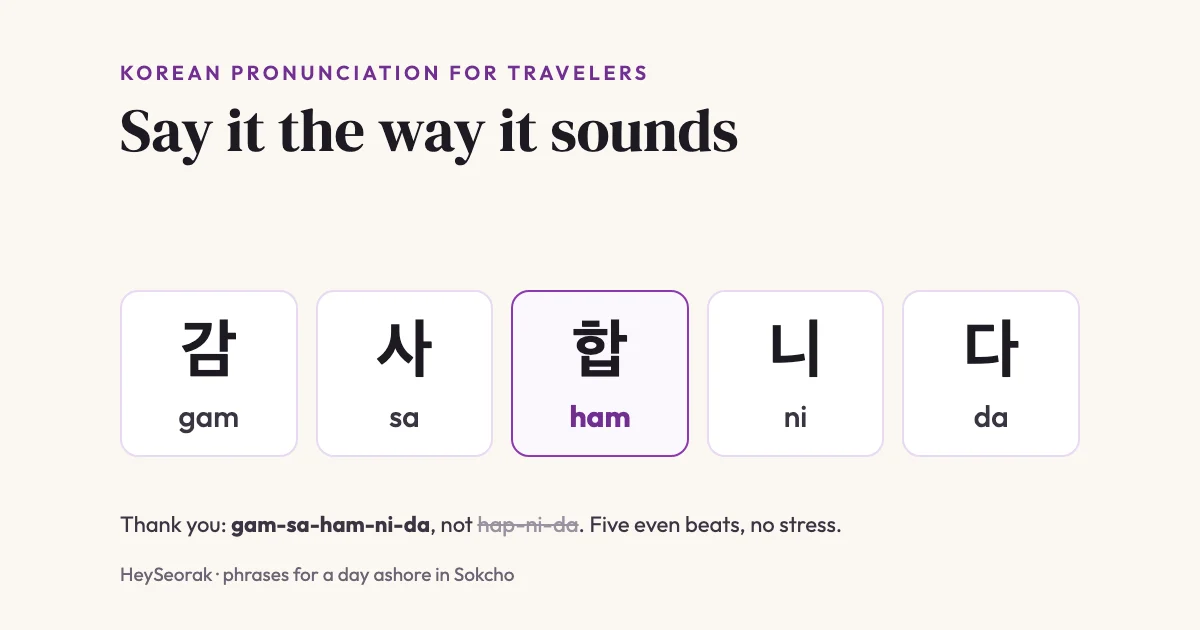
Quick answer: Korean pronunciation is easier than romanization suggests. Say every syllable with the same length and no stress, read eo as "uh", and say 감사합니다 as gam-sa-ham-ni-da, not "gam-sa-hap-ni-da." For a day in Sokcho you need about ten phrases: excuse me, I don't speak Korean, where is the toilet, how much, and "to the cruise terminal, please." When a phrase does not land, show the Hangul on your phone.
When we helped passengers at the Sokcho cruise terminal on a 2026 call day, one of the three questions we heard most, along with "where is an ATM" and "where is Olive Young," was "How do I say this in Korean?" Usually followed by a phone held up with a romanized phrase that, read out letter by letter, a Korean listener would not recognise.
The phrases themselves are not the problem. The spelling is. This guide fixes the six sounds that trip English speakers up, then gives you 34 phrases for a day ashore, written the way they are actually spoken.
For ordering food, see our separate Korean phrases for restaurants. This page covers everything else.
How to read the respellings
Every phrase below has three columns: what it means, the Korean to show on your phone, and Say it, a respelling of how it sounds.
- Respellings keep the standard eo and eu spellings you will see on signs; the six sounds below tell you how to say them.
- Other vowels are simple: a = "ah", i = "ee", u = "oo", o = "oh", e and ae = "eh", wa = "wah".
- Hyphens split syllables, not words. Give each syllable the same length.
- No syllable is stressed. English puts weight on one beat ("thank YOU"); Korean keeps them level. Saying everything flat sounds more natural, not less.
- A yes/no question rises on the last syllable. With 어디 (where) or 얼마 (how much), a gentle rise is enough.
- -yo at the end is the polite ending. Keep it: dropping it sounds too casual to a stranger.
Korean pronunciation: the six sounds English speakers get wrong
1. eo is "uh," not "ee-oh"
The vowel ㅓ is romanized eo, and it is one sound: an open "uh," lips relaxed, like the u in "up." 어디 (where), written eo-di here, sounds like "uh-di." 저기요 (excuse me), jeo-gi-yo, sounds like "juh-gi-yo."
Its neighbour ㅗ (o) is a rounded "oh," lips pushed forward. Mixing them up changes the word, so if a phrase is not landing, check your eo.
2. eu is "uh" with your lips spread
ㅡ (eu) is not eo. Spread your lips as if smiling and say a relaxed "oo" without rounding them. 크루즈 (cruise) is keu-ru-jeu: give each syllable, including the last, a full beat.
3. Three kinds of k, t, p and ch
Korean has three versions of each of these consonants. Hold your hand in front of your mouth:
| Type | Example | What to do |
|---|---|---|
| Plain | 가 (ga) | Soft; little air. Sounds between English g and k |
| Aspirated | 카 (ka) | A strong puff of air, stronger than English k |
| Tense | 까 (kka) | No air at all; tighten your throat, like the k in "sky" |
Respellings write the tense ones doubled: kk, tt, pp, jj, ss. 좀 깎아 주세요 (a small discount, please) is jom kka-kka ju-se-yo: two tight, airless k's.
4. p before n becomes m: the 감사합니다 rule
This is the one almost every visitor gets wrong. When ㅂ (p) meets ㄴ (n) or ㅁ (m), it turns into m, under Article 18 of the Standard Pronunciation rules of the National Institute of Korean Language. So:
- 감사합니다 (thank you) is gam-sa-ham-ni-da, never "hap-ni-da"
- 죄송합니다 (I'm sorry) is jwe-song-ham-ni-da
The same thing happens to ㄱ (k) before n, which becomes ng, and to ㄷ/ㅅ (t) before n, which becomes n. 있는 (that has) is in-neun.
5. t plus h makes a hard t
When a syllable ending in t meets one starting with h, they merge into one aspirated t (Article 12). That is why 한국어 못 해요 (I don't speak Korean) is han-gu-geo mo-tae-yo, not "mot hae-yo."
6. Endings stop, they don't pop
A consonant at the end of a syllable is held, not released. 밥 (rice) ends with your lips closed, no little "puh." When the next syllable starts with a vowel, the consonant slides over: 길을 (the road) is gi-reul, and 몸이 (body) is mo-mi.
If a phrase does not land, don't repeat it louder. Show the Korean on your screen. Every phrase on this page is written in Hangul for exactly that reason.
Getting attention and getting by
| Meaning | Korean | Say it |
|---|---|---|
| Excuse me (to call a shopkeeper) | 저기요 | jeo-gi-yo |
| I don't speak Korean | 한국어 못 해요 | han-gu-geo mo-tae-yo |
| Do you speak English? | 영어 할 줄 아세요? | yeong-eo hal jjul a-se-yo? |
| Please speak slowly | 천천히 말해 주세요 | cheon-cheon-hi mal-hae ju-se-yo |
| Please write it here | 여기 써 주세요 | yeo-gi sseo ju-se-yo |
| What is this? | 이거 뭐예요? | i-geo mwo-ye-yo? |
| Can I take a photo? | 사진 찍어도 돼요? | sa-jin jji-geo-do dwae-yo? |
저기요 is how Koreans call staff in a shop or restaurant. It is polite, not abrupt. "Please write it here" gets you a price or an address on paper, which beats any phrase.
Where is…?
| Meaning | Korean | Say it |
|---|---|---|
| Where is the toilet? | 화장실 어디예요? | hwa-jang-sil eo-di-ye-yo? |
| Can I use the toilet? | 화장실 써도 돼요? | hwa-jang-sil sseo-do dwae-yo? |
| Where is an ATM? | ATM 어디 있어요? | ei-ti-em eo-di i-sseo-yo? |
| Where is Olive Young? | 올리브영 어디 있어요? | ol-li-beu-yeong eo-di i-sseo-yo? |
| Where do I take the shuttle bus? | 셔틀버스 어디서 타요? | syeo-teul-beo-seu eo-di-seo ta-yo? |
| I'm lost | 길을 잃었어요 | gi-reul i-reo-sseo-yo |
Koreans say "ATM" in English letters (ei-ti-em, read "ay-tee-em"), so you don't need the formal Korean word. For the answers, see our guides to ATMs in Sokcho and Olive Young, Daiso and E-mart. The walking map shows restrooms, ATMs and shops.
Shopping and the market
| Meaning | Korean | Say it |
|---|---|---|
| How much is it? | 얼마예요? | eol-ma-ye-yo? |
| I'm just looking | 그냥 구경할게요 | geu-nyang gu-gyeong-hal-kke-yo |
| Can I try it? (taste) | 맛봐도 돼요? | mat-ppwa-do dwae-yo? |
| A small discount, please | 좀 깎아 주세요 | jom kka-kka ju-se-yo |
| I'll take this one | 이걸로 할게요 | i-geol-lo hal-kke-yo |
| A bag, please | 봉투 주세요 | bong-tu ju-se-yo |
| Gift wrap, please | 선물 포장해 주세요 | seon-mul po-jang-hae ju-se-yo |
| Can I get a tax refund? | 택스 리펀드 돼요? | taek-seu ri-peon-deu dwae-yo? |
| What time do you close? | 몇 시까지 해요? | myeot ssi-kka-ji hae-yo? |
Notice the kk in 할게요: the -ge in -(l)ge-yo tightens, so it is hal-kke-yo, not "hal-ge-yo" (Article 27). 몇 시 (what time) also tightens, to myeot ssi, because a consonant after a t-sound ending turns tense (Article 23).
Haggling with 좀 깎아 주세요 works at market stalls and small shops, never at chains like Olive Young or E-mart. Say it with a smile; a no is a no. For what to buy and taste there, see our Sokcho Tourist & Fishery Market guide.
Taxi phrases for getting back to the Sokcho cruise terminal
| Meaning | Korean | Say it |
|---|---|---|
| To the cruise terminal, please | 크루즈 터미널로 가 주세요 | keu-ru-jeu teo-mi-neol-lo ga ju-se-yo |
| Here, please (pointing at your phone) | 여기로 가 주세요 | yeo-gi-ro ga ju-se-yo |
| How long does it take? | 얼마나 걸려요? | eol-ma-na geol-lyeo-yo? |
| Can I pay by card? | 카드 돼요? | ka-deu dwae-yo? |
For the drive back, show the driver the full name on your phone: 속초항 국제크루즈터미널 (Sokcho Port International Cruise Terminal). Sokcho taxis take Korean cards and usually Visa and Mastercard; keep some cash as backup. See Sokcho taxi fares and tips.
If something goes wrong
| Meaning | Korean | Say it |
|---|---|---|
| Help! | 도와주세요! | do-wa-ju-se-yo! |
| Please call the police | 경찰 불러 주세요 | gyeong-chal bul-leo ju-se-yo |
| Please call an ambulance | 구급차 불러 주세요 | gu-geup-cha bul-leo ju-se-yo |
| I don't feel well | 몸이 안 좋아요 | mo-mi an jo-a-yo |
| It hurts here | 여기가 아파요 | yeo-gi-ga a-pa-yo |
Emergency numbers: 112 for police, 119 for ambulance and fire. For travel help in English at any hour, call the Korea Tourism Organization's travel hotline on 1330 (+82-2-1330 from a foreign phone).
Thank you, sorry and goodbye in Korean
| Meaning | Korean | Say it |
|---|---|---|
| Thank you | 감사합니다 | gam-sa-ham-ni-da |
| I'm sorry / excuse me | 죄송합니다 | jwe-song-ham-ni-da |
| Goodbye (you leave, they stay) | 안녕히 계세요 | an-nyeong-hi gye-se-yo |
Leaving a shop, you say 안녕히 계세요, "stay in peace." The shopkeeper answers 안녕히 가세요, "go in peace," because you are the one going.
Before you go ashore
- Download offline Korean in Papago and Google Translate on the ship's Wi-Fi. Papago's camera reads signs and menus.
- Screenshot this page so the Hangul is there without signal.
- Learn three phrases well rather than thirty-four badly: 저기요, 감사합니다 and 화장실 어디예요? cover most of a day ashore.
- For food, take our restaurant phrase guide too.
- Planning the whole day? See the Sokcho cruise day guide.
How we checked this
Respellings write each phrase as it is spoken, applying the Standard Pronunciation rules published by the National Institute of Korean Language (국립국어원): nasalization (Article 18), aspiration with ㅎ (Article 12) and tensing (Articles 23 and 27). The phrase list comes from questions cruise passengers asked us at the Sokcho cruise terminal in 2026, and leaves out the restaurant phrases already in our restaurant phrase guide.
Korean pronunciation FAQ
How do you pronounce thank you in Korean?
감사합니다 (thank you) is spoken gam-sa-ham-ni-da. The Hangul spells the third syllable 합 (hap), but under Korean's standard pronunciation rules a p before n turns into m, so never say 'hap-ni-da'. Give all five syllables the same length with no stress on any of them, and let the voice fall at the end. 죄송합니다 (sorry) follows the same rule: jwe-song-ham-ni-da.
How do I say 'I don't speak Korean' in Korean?
한국어 못 해요 is said han-gu-geo mo-tae-yo. The final ㅅ of 못 sounds like t, and a t followed by the h of 해 merges into one aspirated t, a t with a puff of air, so it is never 'mot hae-yo'. Keep the polite -yo ending, and if the listener still looks puzzled, show them the Hangul on your phone.
Why does Korean romanization not match how words sound?
Korean changes sounds where syllables and words meet: p before n becomes m, t plus h becomes a hard t, and a g or j after an -l ending, as in 할게요, tightens. Phrasebooks often romanize the spelling and miss these changes. Respellings in this guide write the spoken result.
What does eo mean in Korean romanization?
Eo is the Korean vowel ㅓ, a single open 'uh' sound with relaxed lips, close to the u in the English word 'up'. It is never two sounds like 'ee-oh'. Seoul (서울) is pronounced roughly 'suh-ool', and 어디 (where), romanized eo-di, sounds like 'uh-di'. Its neighbour o (ㅗ) is a rounded 'oh', so mixing the two changes the word.
What Korean phrases do I need for a cruise stop in Sokcho?
Start with five: 저기요 (jeo-gi-yo, excuse me), 한국어 못 해요 (han-gu-geo mo-tae-yo, I don't speak Korean), 화장실 어디예요? (hwa-jang-sil eo-di-ye-yo, where is the toilet?), 얼마예요? (eol-ma-ye-yo, how much?) and 크루즈 터미널로 가 주세요 (keu-ru-jeu teo-mi-neol-lo ga ju-se-yo, to the cruise terminal, please). Show the Hangul on your phone whenever a phrase does not land.