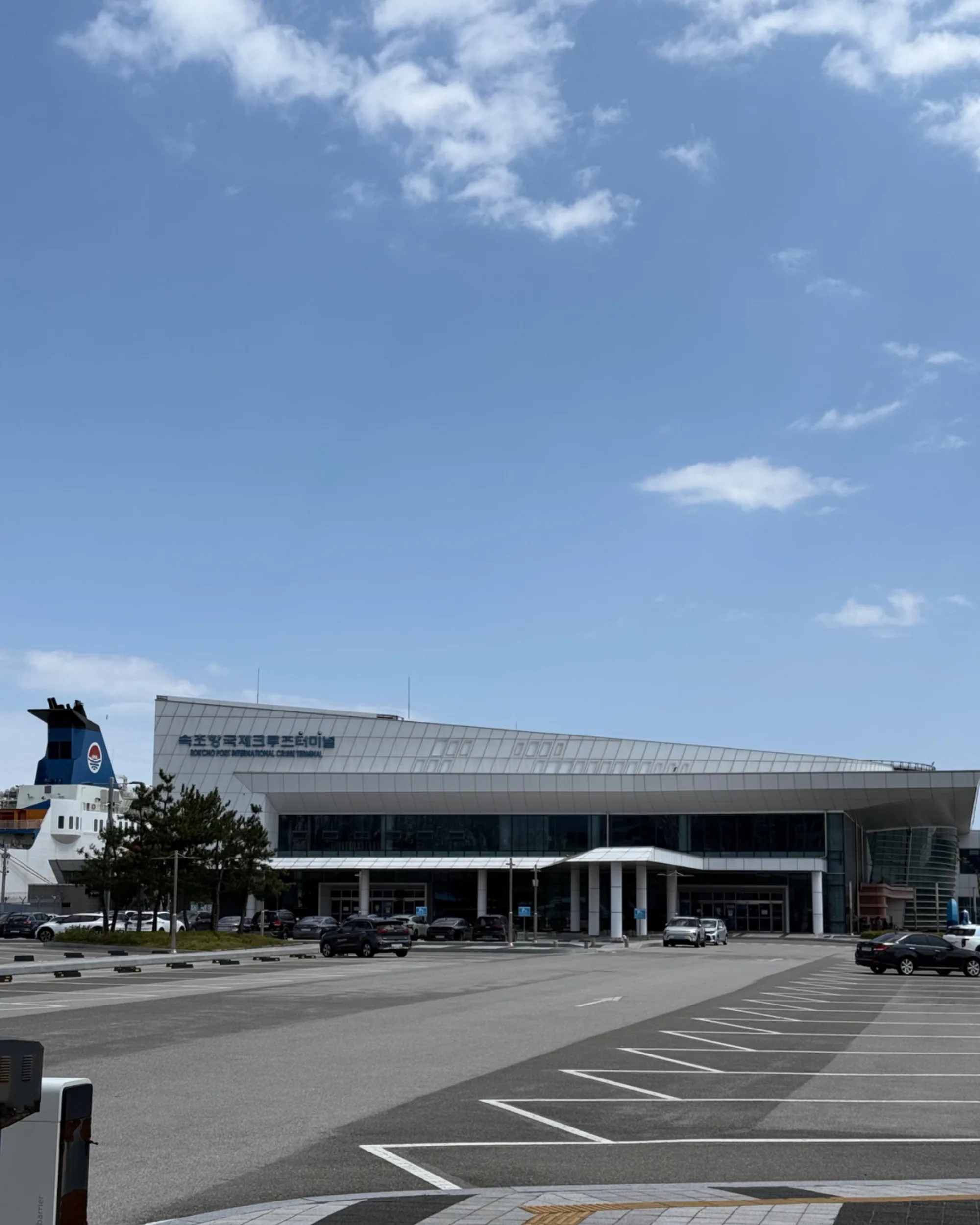
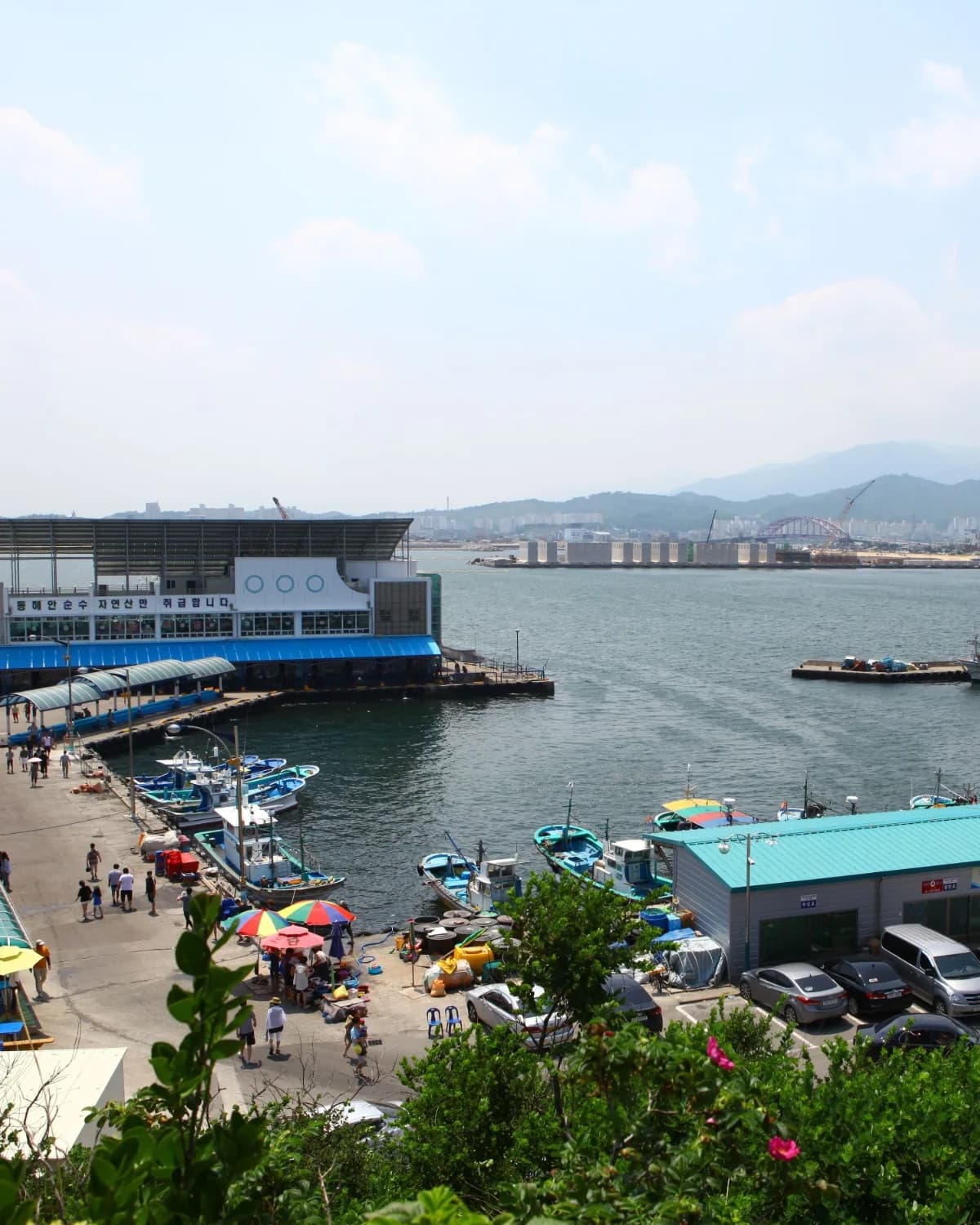
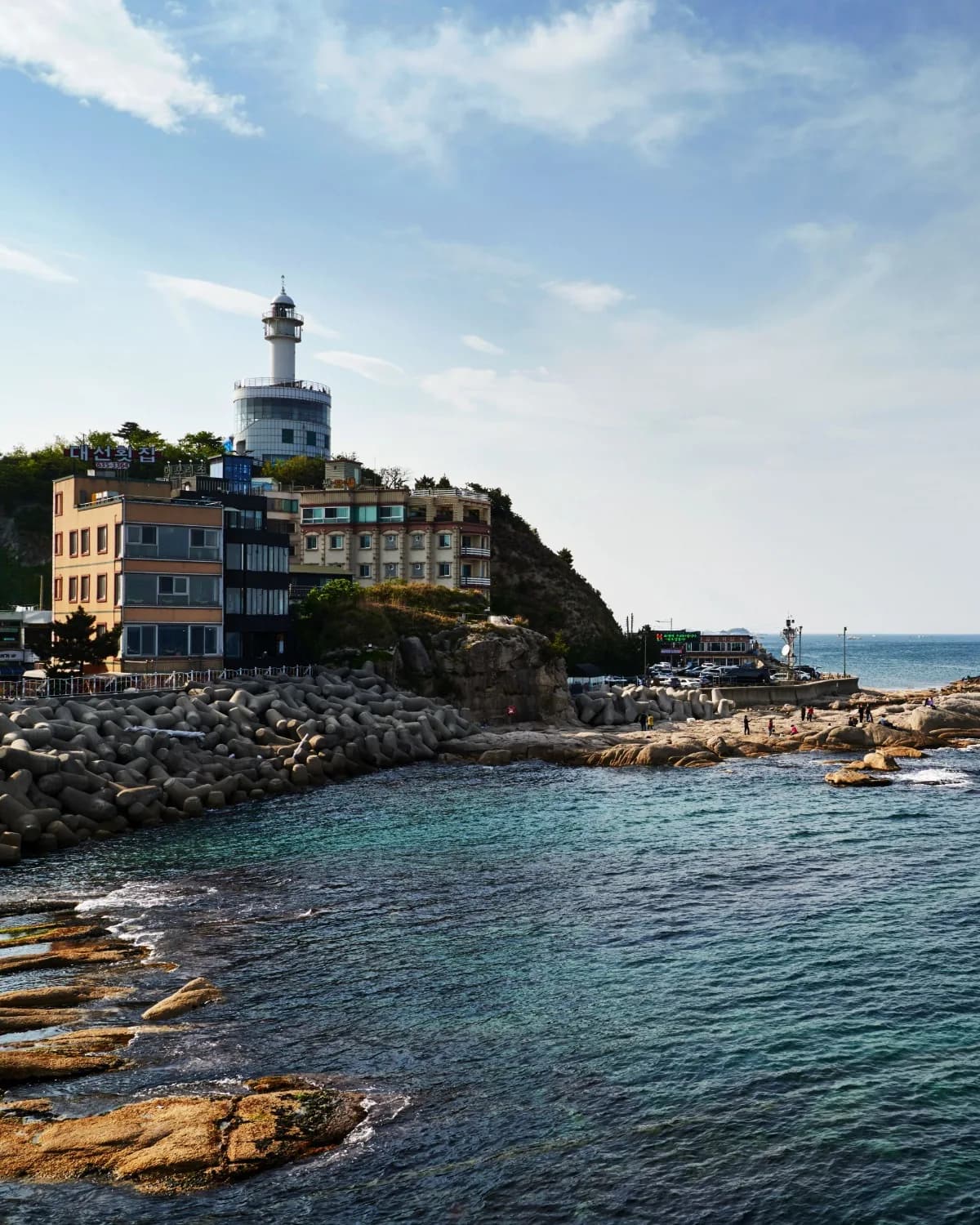
The harbor arc north of the Sokcho cruise terminal is what every arriving passenger photographs from the deck, and then most of them get bussed straight past it to the market. This Sokcho Lighthouse Observatory walk goes the other way: through Abai Village, over the harbor channel, along the quay to Dongmyeong Port, out onto the rocks at Yeonggeumjeong, and up the lighthouse hill to a deck that reopened in June 2026 after a full renovation. It ends on the sand at Lighthouse Beach, with lunch a block away.
We walked it on 4 September 2026 with a GPS track running. The line on the walking map is that track, not a guess, and the restrooms and free Wi-Fi marked on it come from Sokcho City's own inventory.
Route at a glance
| Distance | 3.1 km one way (GPS-walked 2026-09-04) |
| Walking time | About 45 min, plus stops |
| Plan for | 2.5 h without lunch, 3.5 h with |
| Fits a shore window of | 4 h (2 h version turns at Yeonggeumjeong) |
| Terrain | Flat pavement and quay; one bridge ramp; stairs at the lighthouse |
| Start | Sokcho Cruise Terminal (속초항 크루즈터미널) |
| Finish | Lighthouse Beach (등대해변) |
| Lighthouse hours | Tower and deck 09:00–17:00, grounds 09:00–18:00, daily, free |
| Return | Retrace, or taxi from Dongmyeong Port (about 10 min to the terminal) |
Turn by turn
Street names below are English first with the Korean sign in parentheses, and the metre marks are from the terminal gate.
- 0 m. Sokcho Cruise Terminal (속초항 국제크루즈터미널). Leave by the main gate. The taxi stand and, on call days, the exchange booth and the free market shuttle are all in the parking lot in front of you. Ignore the shuttle; walk.
- 400 m. Abaimaeul 1-gil (아바이마을1길), then Abaimaeul-gil (아바이마을길). Turn into the lanes of Abai Village, the refugee settlement on the sandbar. Low houses, drying racks, a few sundae restaurants. The Coast Guard substation (속초해양경찰서 파출소) at about 620 m has a restroom you can use during office hours.
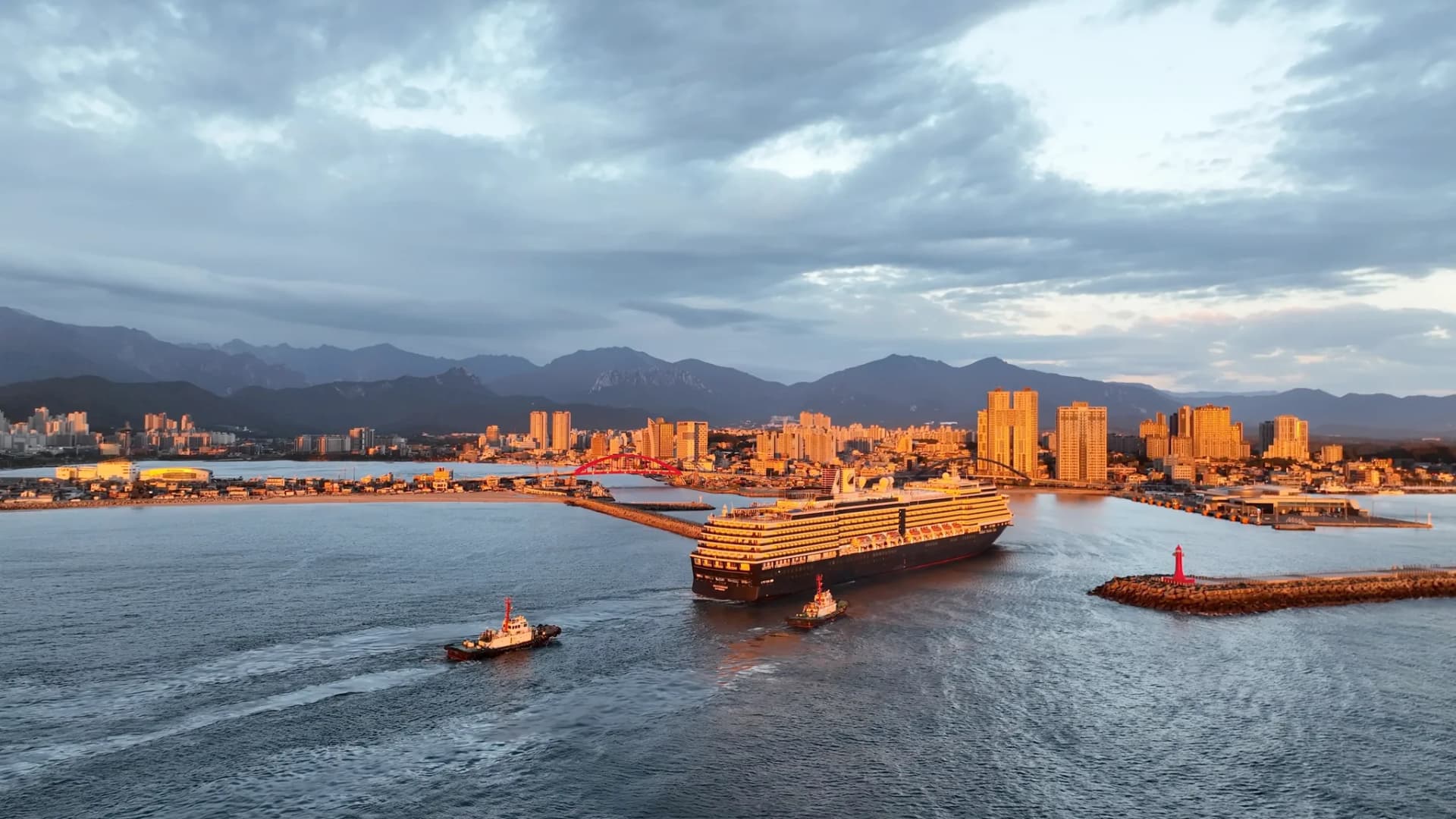
- 820 m. Seorakgeumgangdaegyo-ro (설악금강대교로). This is the road deck of Seorak Bridge (설악대교). Climb onto it and cross the channel where Cheongchoho Lagoon drains into the sea. The ramp is the only real gradient before the lighthouse. There is an elevator at the Abai Village end of the bridge if you want to skip the ramp. From the deck, look right: the ship you came in on, the breakwater lighthouses and the whole arc you are about to walk.
- 1,110 m. Jungang-ro (중앙로). Come down off the bridge and turn right onto the harbor side of Jungang-ro. This stretch is Sokcho Port, the big-ship end: the coast guard pier, the domestic passenger terminal, the port support center. A public restroom sits at the government pier (동명항 관공선 부두) just as you arrive.
- 1,255 m. Subok Tower Intersection (수복탑사거리). Subok Tower (수복탑) is the small monument in the park on your left, put up in 1954 for the families who came south and waited here to go home. The park has free public Wi-Fi (수복탑공원). Cross straight over.
- 1,345 m. Dongmyeonghang-gil (동명항길). The quay road. Follow it with the water on your right for half a kilometre. It passes the international passenger ferry terminal (속초항 국제여객터미널) and the Coast Guard civil-service office (속초해양경찰서 종합민원실), which has a restroom during its opening hours.
- 1,815 m. Yeonggeumjeong-ro 2-gil (영금정로2길). The quay bends and the tanks start. This is Dongmyeong Port proper, the live-fish center (동명항활어) and the raw-fish stalls. The public restroom marked Dongmyeong Port (동명항) is here.
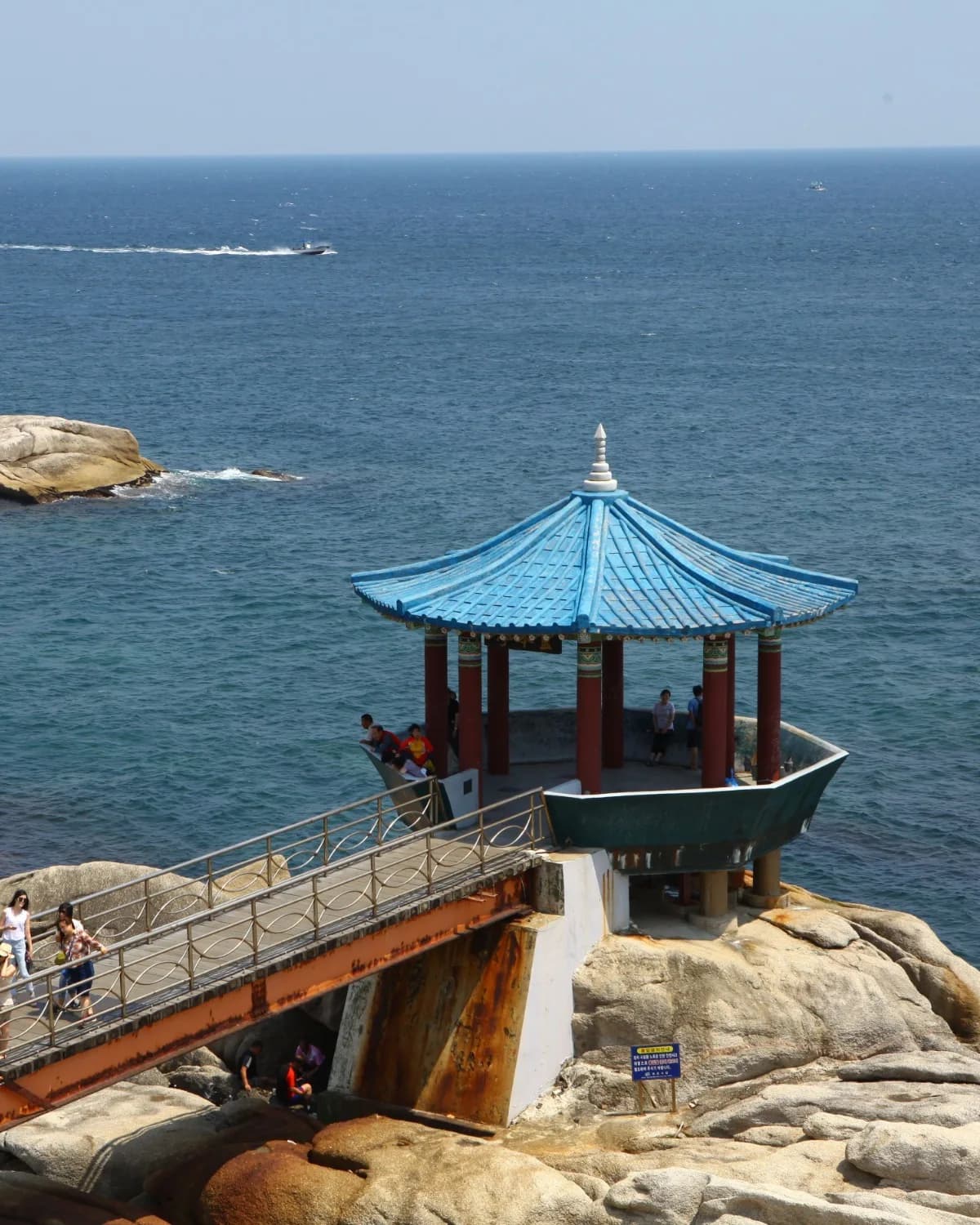
- 2,080 m. Yeonggeumjeong (영금정). At the seaward end of the port, the bridge goes out to the sea pavilion. Free Wi-Fi at the pavilion entrance (영금해맞이정자). The restroom labelled Yeonggeumjeong Pavilion (영금정) is 200 m on, by the road up.
- 2,190 m. Yeonggeumjeong-ro (영금정로) / Yeongnang Coastal Road (영랑해안길). Back on land, keep the sea on your right and pass the Yeonggeumjeong certification stamp box for the East Coast cycle route (영금정 인증센터).
- 2,610 m. Sokchodeungdae-gil (속초등대길). The lighthouse lane. Go up through the bamboo to the Sokcho Lighthouse Observatory, then come back down the same lane.
- 2,700–3,000 m. Yeongnanghaean 1-gil (영랑해안1길), 6-gil (영랑해안6길), 7-gil (영랑해안7길), 8-gil (영랑해안8길). The short lanes of the old Yeongnang fishing quarter between the lighthouse and the beach. Two restrooms here: Yeongnang-dong seawall (영랑동 해안방파제) and Yeongnang-dong lighthouse (영랑동 등대), and a third at the old Yeongnang Market ((구)영랑시장). Ondo Kitchen and Seojubang are on these lanes.
- 3,140 m. Lighthouse Beach (등대해변). The sand. The toilet at the beach is the basic no-flush kind, so use the Yeongnang-dong ones if you can.
The walk in detail
Terminal to Dongmyeong Port
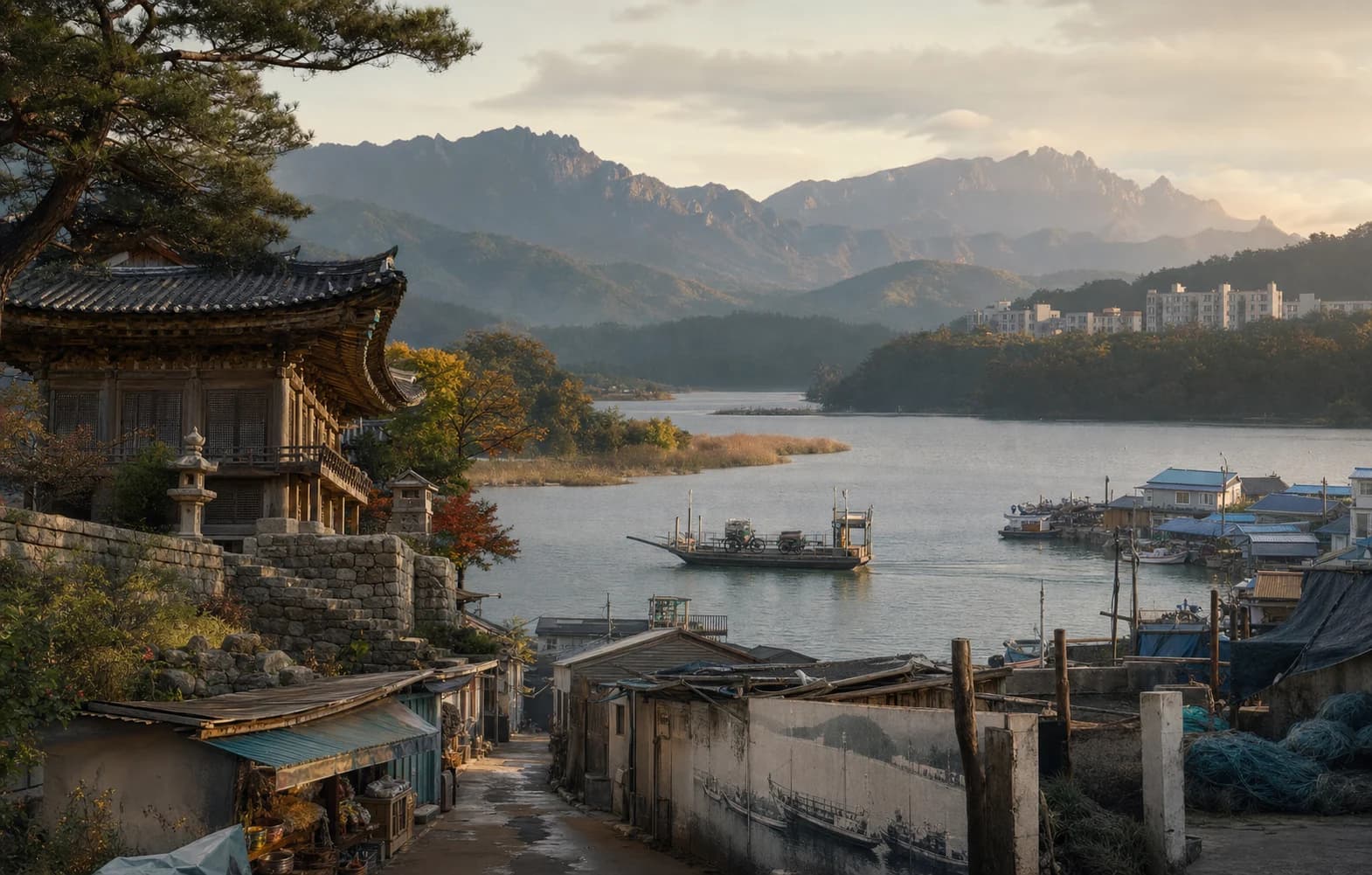
The first kilometre is the part nobody expects. Instead of following the harbor road, the track cuts through Abai Village, the sandbar neighbourhood settled by Korean War refugees from Hamgyeong Province who expected to go home in a season and stayed for a lifetime. The lanes are narrow and quiet in the morning. If you want more of this story, the Cruise Day in Sokcho route spends its whole first hour here; this one only passes through.
Seorak Bridge lifts you over the channel. It is a road bridge with a proper footpath, and the view from the middle is the reason to take it rather than the flat quay: the cruise ship behind you, the two breakwater lights at the harbor mouth, Dongmyeong Port ahead with the lighthouse hill above it, and on a clear day the Seorak ridge stacked behind the town. The elevator at the village end takes the ramp out of the equation for anyone who needs it.
Down on Jungang-ro the harbor turns industrial for a few hundred metres. Coast guard cutters, the domestic ferry terminal, a cargo quay. Keep walking. Subok Tower, in its small park at the crossroads, is worth thirty seconds. Subok means "recovery of the north"; the monument was put up in 1954 by people who could see their home province from this coast and could not reach it. The park's free Wi-Fi is the last reliable signal before the port.
Dongmyeonghang-gil is the quay itself, and it is where the walk becomes what you came for. Fishing boats tied three deep, nets stacked on the concrete, gulls on every bollard. The Dongmyeong Port live-fish center at the far end is run by the Sokcho fisheries cooperative: rows of tanks on the ground floor, a dining room above. You choose a fish, it is weighed and cut, and you eat it upstairs with the rice, soup and side dishes that come with it. Prices are chalked by weight and English is thin, but pointing works, and nobody minds you looking. There are no published hours; the tanks are trading from morning to evening and it is busiest around lunch. If you plan to eat raw fish, this is the place, and it is a fair alternative to the lunch stop at the end. If you would rather have cooked fish, keep walking.
Yeonggeumjeong
The name means "the pavilion where the geomungo sounds", after the Korean zither. The story is that waves striking this shelf of rock made a ringing that sounded like the instrument being played. Stand at the rail on a day with any swell and you can hear what they meant.
There are two pavilions, and people confuse them. The sea pavilion, the one in the photographs, sits on the rocks at the end of a short bridge. The hilltop pavilion, the Yeonggeumjeong Sunrise Pavilion (영금정 해맞이정자), stands on the low bluff above it and is reached by a path from the road. Both are free. The Yeonggeumjeong Sunrise Pavilion page has the detail on both.
The sea pavilion has had a rough few years. Its elevator, installed in the 2017 rebuild, was stopped in October 2024 after repeated breakdowns and then removed. Salt had eaten the access stairs badly enough that the whole structure closed from March to July 2025 for a rebuild. It is open again, and the approach is now a gentle ramp rather than steps, which makes this the most accessible sea viewpoint on the route. The one rule that has not changed: the city closes the bridge in strong wind or high swell, sometimes with no warning online. If the gate is shut, the hilltop pavilion is fifty metres away and gives you the same horizon.
This is Sokcho's sunrise spot, and if you are staying in town rather than passing through on a ship, it is worth the alarm. Sunrise at Sokcho is about 06:07 in mid-September, 06:21 on 1 October, 06:34 in mid-October, 06:52 on 1 November and 07:23 by the end of November. Arrive twenty minutes before. Cruise passengers docking in the morning will usually only catch it from the ship's rail, which is not a bad place to catch it.
The Sokcho Lighthouse Observatory
The only climb of the day starts at Sokchodeungdae-gil. A wooden deck path goes up through a bamboo grove, turns into stairs, and comes out at the white tower on top of the bluff, 66 m above the sea. Nobody official publishes a step count; visitors who have counted put it in the range of 150 to 180 including the flights inside the tower. Ten minutes up at an easy pace, five down.
The lighthouse is a working aid to navigation, run by the East Sea Regional Office of Oceans and Fisheries, and it was closed for the spring of 2026. Work started on 23 March and finished on 26 June: the rooftop deck got a new stone floor, the outdoor railings were replaced, and the stairs and walkways were rebuilt. It reopened to the public on 27 June 2026. Hours since then are 09:00 to 17:00 for the tower and its observation deck and 09:00 to 18:00 for the grounds, every day of the year, with no admission charge. That matters for a morning shore call: if you leave the terminal at 08:00 and walk straight here, you will be at the gate before it opens. Do the port and the pavilion first.
From the deck you see everything you just walked, laid out like a map: the port, the pavilion on its rocks, the bridge, the cruise ship at the terminal, and on a clear day the Seorak ridgeline behind the city. If the deck is shut for weather, the grounds around the base still give most of the sea view.
Down to Lighthouse Beach
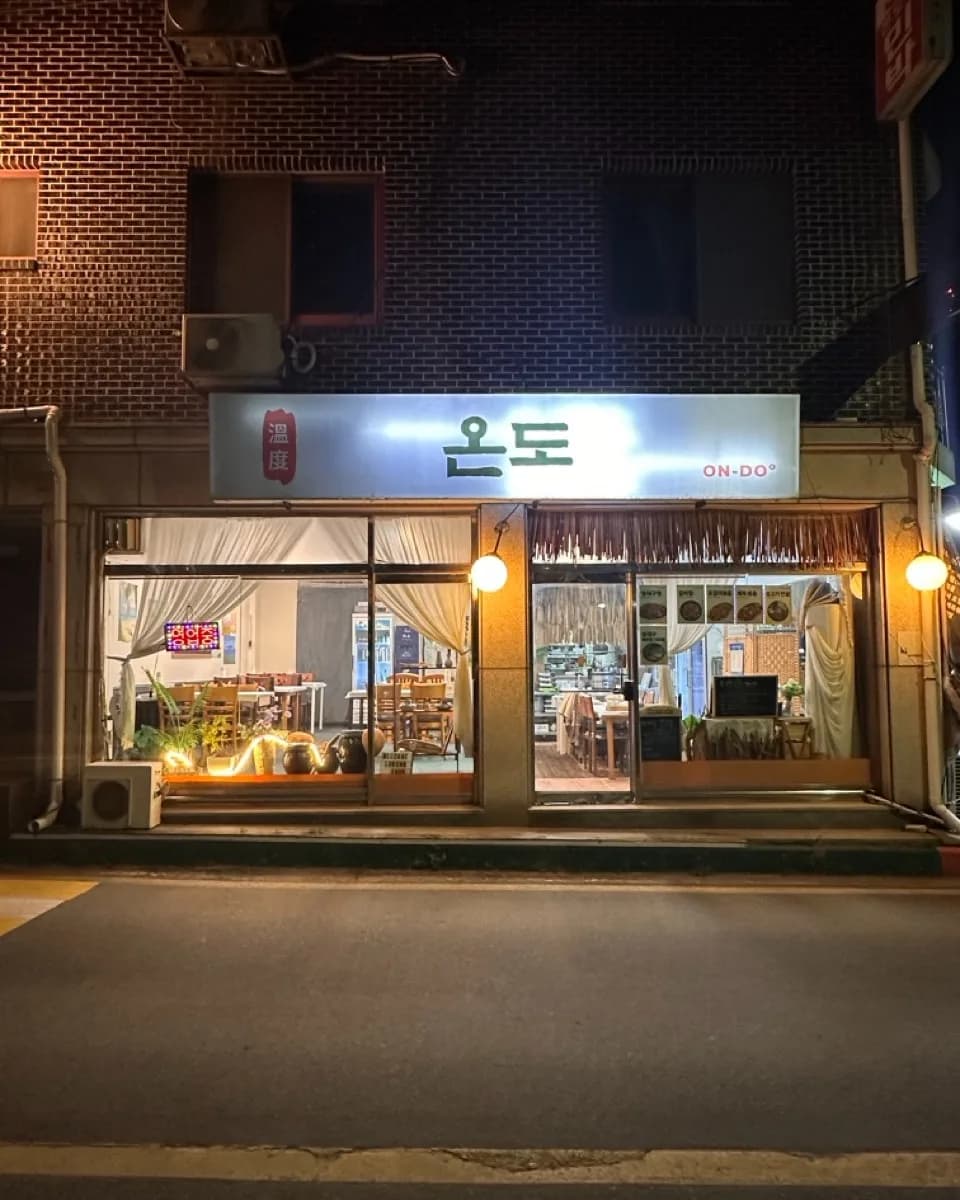
Back down the lane and into the Yeongnang lanes, a fishing quarter that has kept its scale: one-storey houses, a couple of pojangmacha tents, a convenience store. This is where the route's lunch lives. Ondo Kitchen (온도) on Yeongnanghaean 1-gil is a small room where a former dancer turned chef applies Japanese dashi technique to whatever the Sokcho boats brought in that morning. The menu changes with the catch, so read the board or ask; a clear fish broth and a grilled or simmered fish set are the usual shape of it. A block further, Seojubang (서주방) opened in early 2026 on the pojangmacha strip as a fusion Korean pub built around sharing plates and sauces, and it is the better choice for a group that wants variety over one careful fish.
Both are inside 150 m of the track. Neither is large, so a party of eight should split or pick the Dongmyeong live-fish center instead.
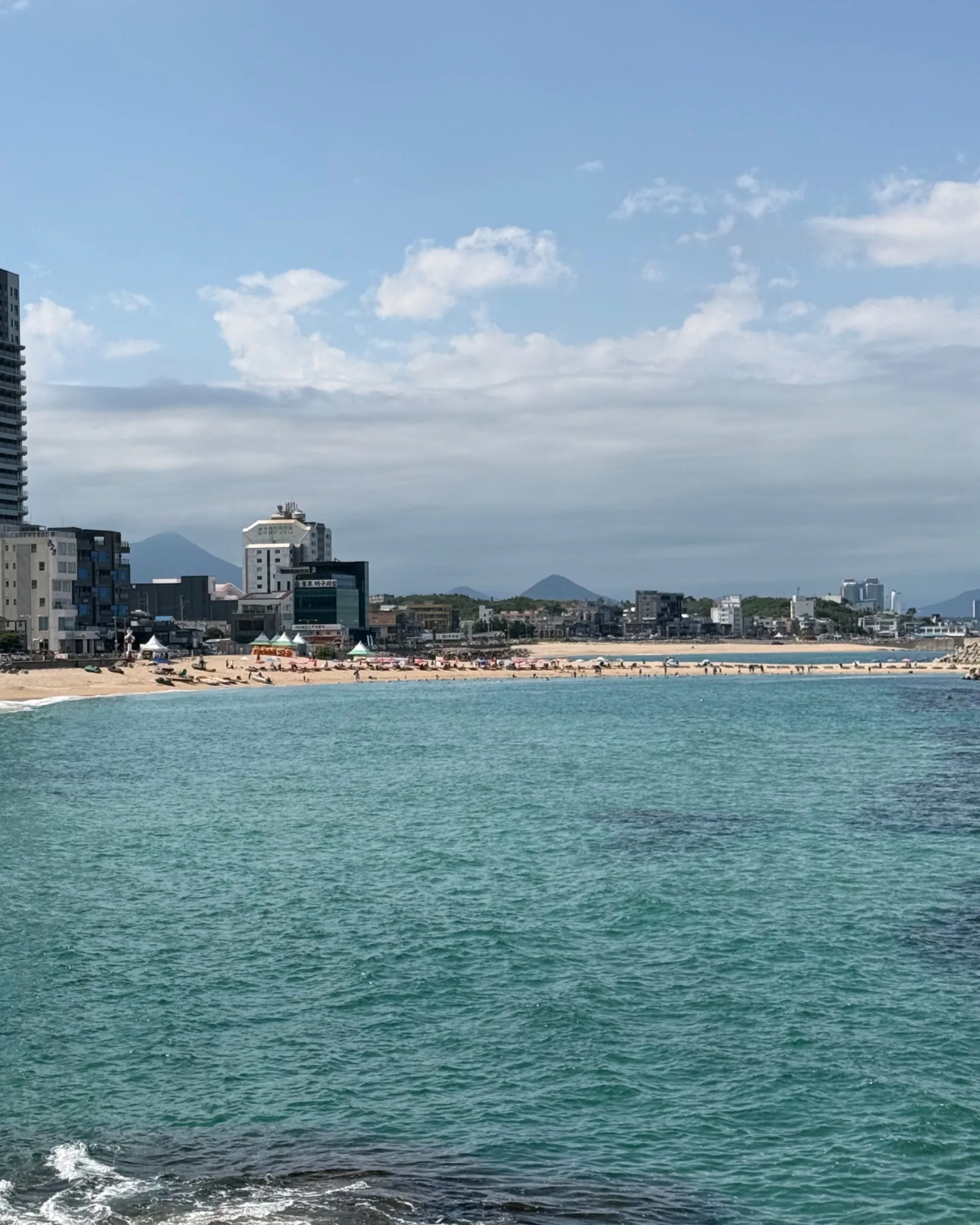
Lighthouse Beach (등대해변) itself is a short strand under the bluff, quieter than Sokcho Beach and with the lighthouse in every photograph. There is a basic toilet at the far end; the proper ones are back in the Yeongnang lanes. This is the end of the line. Sit down for a minute before you decide how to get back.
Cruise day: the shore-window math
The full route is about 45 minutes of walking. Add 15 minutes at Dongmyeong Port, 20 at Yeonggeumjeong, 25 for the lighthouse climb and deck, and 45 to 60 for lunch, and you are at three to three and a half hours before you start back. That fits a four-hour window with a taxi return and is tight with a walked return.
The two-hour version. Walk to Yeonggeumjeong and turn around: 2.1 km out, the port and both pavilions, no climb, and a taxi back from Dongmyeong Port. Ninety minutes with a snack, two hours with a proper look at the fish tanks. Skip the lighthouse and note that the pavilion opens at any hour, so this version works even on an early call.
Return options. Retracing the quay and the bridge is 3.1 km and about 45 minutes, and it is pleasant in the other direction because the ship is in view the whole way. Faster: taxis wait around Dongmyeong Port on busy days, and any taxi will take a card. Ask for the cruise terminal, 크루즈터미널, and expect roughly ten minutes. From Lighthouse Beach, walk back to Dongmyeong Port first; taxis are scarce in the Yeongnang lanes.
All-aboard buffer. Whatever the ship says, be at the terminal gate an hour before all-aboard. That leaves time for the security line and for a taxi that takes longer than it should on a call day.
Money and signal. Card works everywhere on this route except some market-style stalls at Dongmyeong Port, so carry a little cash for dried fish. Free public Wi-Fi is at the terminal, Subok Tower park and the Yeonggeumjeong pavilion entrance; the HeySeorak map is precached, so the route, the restrooms and the Wi-Fi pins all work with no signal at all.
Restrooms and Wi-Fi along the way
All of these are from the Sokcho City inventory (September 2026) and sit within 80 m of the track.
| Metres | Facility | Korean sign | Note |
|---|---|---|---|
| 0 | Cruise terminal Wi-Fi | 속초항 국제 크루즈 터미널 | Indoors |
| 620 | Coast Guard substation restroom | 속초해양경찰서 파출소 | Office hours |
| 1,120 | Dongmyeong Port government pier restroom | 동명항 관공선 부두 | Public |
| 1,240 | Subok Tower Park Wi-Fi | 수복탑공원 | In the park |
| 1,720 | Coast Guard civil-service office restroom | 속초해양경찰서 종합민원실 | Office hours |
| 1,940 | Dongmyeong Port restroom | 동명항 | Public |
| 2,070 | Yeonggeum Sunrise Pavilion Wi-Fi | 영금해맞이정자 | Pavilion entrance |
| 2,300 | Yeonggeumjeong Pavilion restroom | 영금정 | Public |
| 2,690 | Yeongnang-dong seawall restroom | 영랑동 해안방파제 | Public |
| 2,820 | Yeongnang-dong lighthouse restroom | 영랑동 등대 | Public |
| 2,930 | Old Yeongnang Market restroom | (구)영랑시장 | Public |
| 3,140 | Lighthouse Beach toilet | 등대해변 | Basic, no flush |
If the weather turns
Sea-rock walkways and lighthouse decks are the first things Sokcho closes when the swell picks up, and the East Coast gets its worst swell in autumn and winter with no rain to warn you. If the forecast shows wind, expect the Yeonggeumjeong bridge to be shut and possibly the lighthouse deck as well. The port and the hilltop pavilion still work. If it is actually raining, switch to the Rainy Day in Sokcho plan and keep this walk for a clear morning.
Keep walking
This route pairs with Cruise Day in Sokcho, which covers the market, the Gaetbae ferry and Abai Village on the other side of the channel, if your shore window runs to six hours. For the history layer under both, the Sokcho History Itinerary picks up where the waterfront leaves off. Independent travellers with a car-free day should read Sokcho Without a Car.
Sources
- Aju Business Daily, 26 June 2026: Sokcho Lighthouse reopens on the 27th after renovation (hours, works, no closing days)
- Visit Korea: Sokcho Lighthouse Observatory (free entry, deck path through the bamboo grove)
- Badatime: Sokcho sunrise and sunset table (sunrise times)