
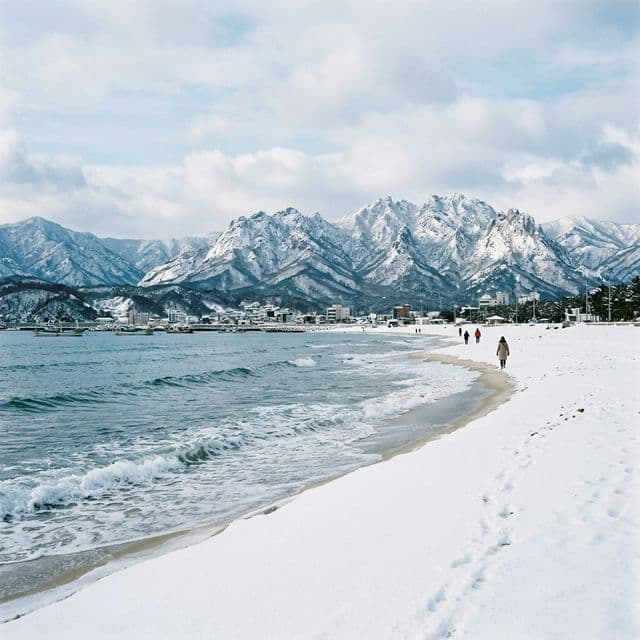
Most visitors picture Sokcho in autumn — the blazing foliage, the packed cable car, the golden hour over Ulsanbawi. Fair enough. But the travelers who come back tend to prefer a different season entirely.
Winter strips the east coast down to its essentials. The mountains go white. The beaches empty. The restaurants fill with steam and the smell of simmering fish stock. It is colder, quieter, and — for a certain kind of traveler — dramatically better.
Why Winter Works
From December through February, Sokcho's daytime temperatures hover between -5 and 5 degrees Celsius (23-41 F). Cold, but manageable with proper layers. In exchange for that chill, you get shorter queues at every restaurant, easier access to Mt. Seorak, and a pace that feels closer to how locals actually experience the city.
Accommodation prices drop. Parking near the national park, a genuine headache in peak season, becomes effortless. And the food — the food is the real argument.
Crab Season: The Main Event
Winter is snow crab season on the east coast, and Sokcho is its capital. Hong-ge (red snow crab) runs from roughly November through May, with the larger, more prized dae-ge (king snow crab) peaking later in spring.
The essential winter crab experience:
Yes Su-san — The hong-ge dosirak (crab lunch box, ~W26,000-36,000) is a Sokcho signature: a whole steamed crab served with rice, banchan, and the quiet satisfaction of cracking shells while wind howls off the East Sea. This is the single dish most worth traveling for in winter.
Snow crab prices fluctuate significantly with catch and weather. Budget roughly W26,000-36,000 per person for hong-ge, and considerably more for the premium dae-ge. Ask the restaurant what came in that morning — the freshest catch is always the best value.
The Hot-Soup Circuit
Beyond crab, winter is when Sokcho's soup and stew culture reaches its peak. Three essential stops:
Hwang Daegutang — Hot cod soup (daegutang, ~W16,000). A milky, deeply savory broth with chunks of fresh cod, radish, and tofu. This is the kind of bowl that makes you understand why Koreans consider soup a complete meal. Best on the coldest mornings.
Haksapyeong Sundubu Village — Bubbling soft tofu stew (~W9,000) made from locally produced sundubu. The village sits slightly inland, a cluster of restaurants all serving variations on the same theme. The value is extraordinary — a full, warming meal for under ten thousand won.
The Tourist & Fishery Market — Hotteok (sweet filled pancakes) and sundae (blood sausage) from the market stalls hit differently when you are genuinely cold. Walk the covered corridors with something hot in your hand and steam rising from every vendor's griddle.
Mt. Seorak Under Snow
The national park is stunning in winter. Snow transforms the granite peaks into something almost alpine, and the Biseondae trail — the most accessible route — takes on a serene quality with ice formations along the creek.
The cable car to Gwongeumseong Fortress runs year-round, weather permitting. On a clear winter day, the views of snow-covered ridgelines from the top are among the finest in Korean hiking. On a cloudy day, you are essentially paying to ride into a white void. Check conditions before committing.
Check the Mt. Seorak National Park website on the morning of your visit. Trails can close due to heavy snowfall or ice. The cable car suspends operations in high winds — this happens more often than you would expect in January and February.
Microspikes or light crampons make an enormous difference on the icy trails. Most outdoor shops near the park entrance sell basic sets if you did not bring your own.
Winter Beach Walks
Sokcho Beach in winter is hauntingly empty. The cold air is crystalline, the sand is firm, and you can walk the full length without seeing another person. Sunrise is spectacular — the sun rises directly over the East Sea, and in winter the angle is low and golden.
It is not a beach day. It is a walking day, a photography day, a bundled-up-with-coffee day. And in its own way, it is more memorable than any summer afternoon on the same stretch of sand.
Practical Notes
Layers, not bulk. A good thermal base, a fleece mid-layer, and a windproof outer shell will handle almost any winter day in Sokcho. Add hand warmers for the mountain.
Heating is excellent. Korean ondol (floor heating) means that restaurants and guesthouses are genuinely toasty inside. The contrast between the cold air outside and the warm floor inside is one of winter Korea's underrated pleasures.
Transit runs normally. The express bus from Seoul operates the same schedule year-round. The 2.5-hour ride is the same in January as in August.
Book less, wander more. With fewer crowds, winter Sokcho rewards spontaneity. You do not need reservations at most restaurants, you will not wait in line at the cable car, and the whole city feels unhurried. That looseness is the real luxury of the off-season.