
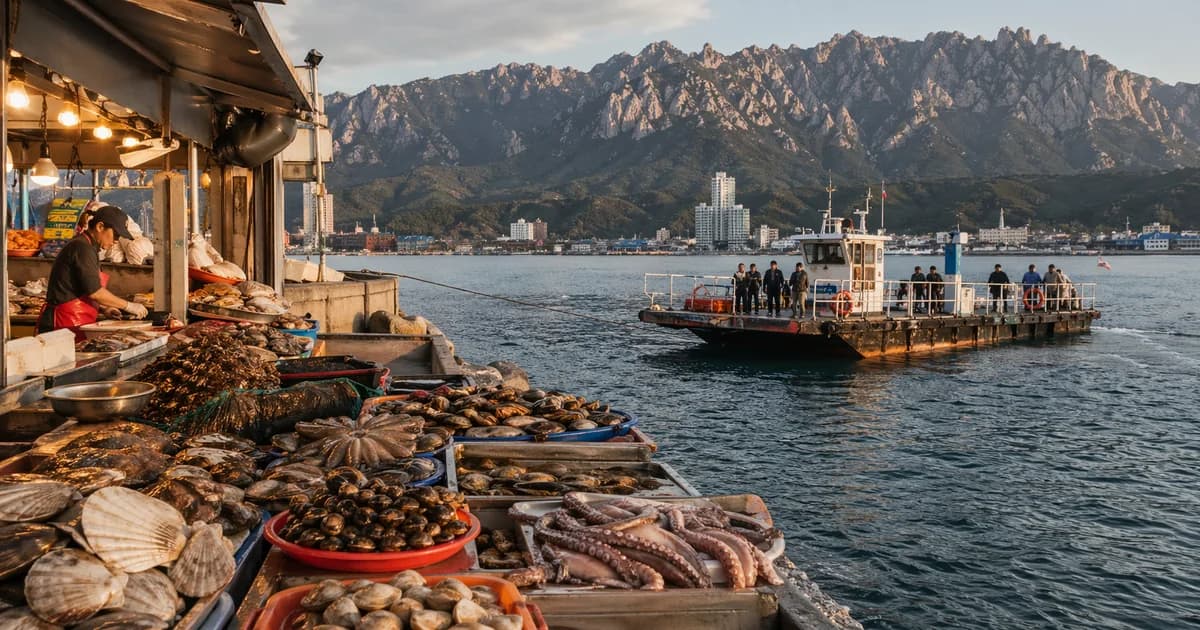
A Sokcho weekend trip is still one of the cleanest two-day escapes from Seoul: mountain first, coast second, seafood throughout. In under 48 hours, you can hike beneath Mt. Seorak's granite ridges, cross Abai Village's hand-pulled ferry, eat through Sokcho Tourist & Fishery Market, and finish at the East Sea without renting a car.
This June 2026 refresh removes older unsourced visitor, beach, and hotel claims and keeps the itinerary anchored to facts that were checked recently: express-bus fares, the delayed rail opening, Mt. Seorak trail-control planning, current market and ferry information, and the latest reported Sokcho visitor/spending data.
Key Takeaways
- Getting there: Express bus from Seoul, about 2h 10-20min on fast services before traffic; current planning fares run about W16,400-34,600 depending on terminal, class, and late-night timing.
- Train status: No passenger train reaches Sokcho yet. March 2026 reporting now points to 2029 as the likely opening window for the Chuncheon-Sokcho railway.
- Budget: W140,000-250,000 per person for a practical shared-room weekend; more if you add crab, sashimi, or a private premium hotel room.
- Day 1: Mt. Seorak main entrance, Sinheungsa, Ulsanbawi, and Biryong Falls, with day-of KNPS trail checks.
- Day 2: Abai Village ferry, Sokcho Beach, Expo Tower, Cheongchoho Lake, and Sokcho Tourist & Fishery Market.
- Verified date: Prices and volatile logistics were checked on June 17, 2026.
Table of Contents
- Why Sokcho Makes the Perfect Weekend Trip
- Getting to Sokcho from Seoul
- Day 1: Mt. Seorak National Park
- Day 2: Coastal Sokcho
- Where to Stay
- Transportation Between Stops
- Budget Breakdown
- What to Pack
- Sources and June 2026 Update Notes
- FAQs
- Further Reading
- Plan Your Perfect Sokcho Weekend
Why Sokcho Makes the Perfect Weekend Trip
Sokcho works because the city compresses three trip types into one weekend: a national-park hike, a working seafood market, and a real coastline. March 2026 local tourism big-data reporting put Sokcho's 2025 outside-visitor count at about 26 million and tourism spending at about W648.4 billion, up from 2024. That does not prove every visitor came for this exact route, so this guide does not pretend it does.
What it does prove is simpler: Sokcho is not a sleepy side trip. It is a high-demand mountain-and-coast city, and weekends need a plan. The itinerary below keeps the high-value stops while leaving enough slack for weather, bus timing, and appetite.
Getting to Sokcho from Seoul
The express bus remains the default choice for most Seoul-based travelers. The train still does not reach Sokcho: March 2026 local reporting says the Chuncheon-Sokcho east-west high-speed rail project is now likely to open around 2029, after delays on several construction sections.
For buses, treat every fare as a live-booking detail. June 2026 checks for Seoul-Sokcho buses show fast trips around 2h 10-20min before traffic, with one-way adult fares in this planning range:
| Route / class | One-way planning fare | Notes |
|---|---|---|
| Dong Seoul standard | W16,400-16,700 | Cheapest useful band; some departures are slower routed services |
| Dong Seoul deluxe | W21,300 | Best default if Gangbyeon is convenient |
| Dong Seoul premium | W26,800 | More space; limited departures |
| Seoul Express standard | W17,200 | Simplest Gangnam departure point |
| Seoul Express deluxe | W22,300 | Good comfort/value default |
| Seoul Express premium | W28,900 | Most comfortable regular daytime option |
| Late-night express classes | W20,600-34,600 | Useful after work; confirm the exact terminal and class before payment |
- Travel time: About 2h 20min in normal conditions.
- Departure point: Seoul Express Bus Terminal is the simplest default; Dong Seoul can also work depending on where you stay.
- Booking: Use Kobus, Bustago, or the terminal app and recheck final fares before payment.
- Return timing: Sunday evening sells out first. Book the return trip when you arrive in Sokcho.
If you are traveling on Friday after work, book deluxe or premium before standard. The price gap is small compared with the cost of losing the best arrival window.
Full transit details: Seoul to Sokcho Guide.
Day 1: Mt. Seorak National Park
Morning: Sinheungsa Temple and Ulsanbawi Rock
Time: 8:00 AM - 12:30 PM
Catch Bus 7 or 7-1 from Sokcho Bus Terminal to Mt. Seorak's main gate. The ride is usually about 30 minutes, but weekend traffic near the park can slow down. Arrive by 8:00 AM if Ulsanbawi is the priority.
At the park entrance, walk ten minutes to Sinheungsa Temple, home to the 14.6-meter bronze Tongil Daebul. Make it a short stop, then continue toward Ulsanbawi Rock.
Ulsanbawi Rock is the main effort of the weekend: roughly 3.8 km one way and 4-5 hours round trip for most visitors. The first two-thirds is forest path. The final stretch is a staircase of around 800 steel steps bolted into granite, with a summit view over Mt. Seorak, Sokcho, and the East Sea.
Admission: Free. Parking: Treat parking as a risk, not a plan. Weekend lots fill early, so the bus is more reliable.
Spring 2026 park notices controlled high routes toward Daecheongbong during the seasonal protection period, while lower routes such as Ulsanbawi, Towangseong Falls Observatory, Waseondae, and Jujeongol remained the practical opening candidates when weather allowed. Conditions can change by rain, wind, ice, or maintenance, so check trail-control information on the morning you hike.
For difficulty ratings and seasonal conditions, see the Ulsanbawi Hike Guide.
Afternoon: Biryong Falls Trail
Time: 1:30 PM - 4:00 PM
After lunch near the trailhead, pivot to Biryong Falls if your legs are still good. It is the softer counterweight to Ulsanbawi: about 5 km round trip, 236 meters of elevation gain, and 1.5-2 hours for most walkers.
The path follows a stream, crosses the red Geumganggul Bridge, passes Yukdam Falls, and finishes at Biryong Falls. It is family-friendly in dry conditions, but it can still be slippery after rain or freeze-thaw weather.
Evening: Dinner in Sokcho
Time: 6:00 PM onwards
Return downtown and keep dinner simple. Two reliable post-hike patterns:
- Soft tofu stew near the Mt. Seorak/Sokcho corridor: plan W10,000-15,000 depending on the restaurant and set.
- Dakgangjeong from the market area: plan roughly W20,000 per box, then confirm at the counter because shop menus and box sizes change.
If you still have energy, walk the Cheongchoho Lake loop at night. It gives you a calmer version of Sokcho after the mountain crowds and before the market crowds.
Day 2: Coastal Sokcho
Day two shifts from granite to water. Keep it mostly car-free and save taxis for weather or fatigue.
Morning: Abai Village
Time: 9:00 AM - 11:30 AM
Start at Abai Village (아바이마을), founded by Hamgyeong-do refugees who settled near the port during the Korean War. The signature arrival is the gaetbae, a non-powered cable ferry across the channel. The fare is W500 per rider, paid by card at a kiosk or in cash on the Abai Village side — crossing from downtown you board first and pay when you land; passengers usually help pull the boat by hook and cable.
The same listing gives the ferry's broad operating window as 05:00-23:00 in summer and 05:30-22:30 in winter, open year-round. Still, do not plan the final minutes of your return bus around it; weather and local operations can change.
Inside the village, try abai sundae or ojingeo sundae. Give yourself 90 minutes to two hours if you want a slow walk and a meal.
Afternoon: Sokcho Beach and Expo Tower
Time: 12:00 PM - 4:00 PM
Walk 15 minutes or ride Bus 9 toward Sokcho Beach. The beach is not complicated, which is the point: sand, boardwalk, cafes, sea air, and an easy reset after the previous day's climb.
Skip old claims about seasonal light-installation schedules unless you verify them from the city before traveling. If your evening depends on a beach event or media-art display, check Sokcho city tourism notices that week.
For a panoramic view, continue to Sokcho Expo Tower by the Cheongchoho Lake area. Current tourism-data listings consistently place the adult ticket at W2,500, with youth at W2,000 and children at W1,500. Use 09:00-22:00 as the planning window and aim to enter by 21:30 if you go at night, because last-entry times are the detail most likely to vary across listings.
The tower is best 30-45 minutes before sunset: Mt. Seorak is still visible, the lake lights come on, and the city feels more compact from above.
Evening: Sokcho Tourist & Fishery Market and Departure
Time: 4:30 PM - 7:00 PM
End at Sokcho Tourist & Fishery Market (the "Jungang Market" most visitors mean). The official market structure is more useful than a generic listing: the complex includes fishery shops, jeotgal sellers, sashimi counters, dried-seafood shops, dakgangjeong vendors, and restaurants. The public parking lot operates on a paid system, with customer parking vouchers commonly tied to a W10,000+ purchase and capped by voucher/time limits. Individual store hours vary, so treat late-night market plans as flexible.
Work through a few of these:
- Dakgangjeong alley for takeout chicken.
- Sundae alley if you did not eat enough in Abai Village.
- Fried seafood around the food lanes.
- Whole crab rice noodle soup at Seodam Ssalguksu if you want a sit-down meal near the market.
Leave the market by 6:30 PM if you want a low-stress return. Later buses exist, but the practical window for most travelers is 19:00-21:00.
Where to Stay
For a first Sokcho weekend, stay near either Sokcho Beach or the Tourist Market / Cheongchoho Lake area.
| Area | Best for | Tradeoff |
|---|---|---|
| Sokcho Beach | Sunrise, beach walks, cafes, terminal access | Less immediate market access |
| Tourist Market / Cheongchoho | Food, evening walks, central bus/taxi access | More urban, less beach atmosphere |
| Mt. Seorak entrance | Early hike start | Poor for day-two coast/market flow without a car |
Use live booking rates instead of stale averages. As a planning band, budget guesthouses and motels often start around W30,000-70,000, mid-range hotels around W80,000-150,000, and premium rooms much higher on weekends or holidays. Friday and Saturday pricing can move fast.
Full neighborhood breakdown: Where to Stay in Sokcho.
Transportation Between Stops
Sokcho is compact, but not every gap is pleasant on foot after a hike. Save your walking energy for the village, beach, lake, and market.
Key routes:
- Sokcho Bus Terminal -> Mt. Seorak entrance: Bus 7 or 7-1, about 30 minutes before traffic.
- Abai Village ferry -> Sokcho Beach: About 20 minutes on foot, or Bus 9.
- Sokcho Beach -> Tourist Market: Bus 1 or 9, usually about 10 minutes once onboard.
Use Naver Map or KakaoMap on the day because city-bus headways are more useful than static route numbers. Taxis between core stops are usually cheap enough to rescue the schedule when weather turns.
For the full car-free playbook, see Sokcho Without a Car.
Budget Breakdown
Every volatile line below was refreshed as a planning estimate on June 17, 2026.
| Item | Cost per person |
|---|---|
| Express bus, round trip | W32,800-69,200 |
| Mt. Seorak entrance | Free |
| Abai Village gaetbae | W500 |
| Expo Tower | W1,500-2,500 |
| Day 1 meals | W25,000-40,000 |
| Day 2 meals | W30,000-50,000 |
| One shared mid-range hotel night | W40,000-75,000 |
| Local bus / occasional taxi | W10,000-15,000 |
| Weekend total (per person) | W140,000-250,000 |
That range assumes shared lodging. Solo travelers paying for a private room should add the full room premium. If the trip is food-led, crab and sashimi are the obvious budget breakers.
Detailed cost analysis: How Much a Sokcho Trip Costs.
What to Pack
Day 1 (Mt. Seorak):
- Hiking shoes with real grip.
- At least 1 liter of water per person.
- Light snacks.
- Weather-appropriate layers; summit and ridgeline wind can feel far colder than downtown Sokcho.
- Small daypack.
Day 2 (coastal):
- Comfortable walking shoes.
- Sunscreen and hat, even outside summer.
- Light jacket for evening coastal wind.
- Camera or phone storage for the beach, lake, and market.
Both days:
- Power bank.
- Cash in W1,000 and W5,000 notes for market stalls and backup situations (the ferry takes cards at its kiosk now).
- Papago or Google Translate with Korean downloaded for offline use.
See also: Korean Phrases for Sokcho.
Sources and June 2026 Update Notes
This page was refreshed on June 17, 2026. For facts that can change quickly, the article now summarizes the operational answer in the article instead of sending readers to outside travel listings.
- June 2026 Seoul-Sokcho bus checks - Dong Seoul and Seoul Express adult fare planning bands, fast-service duration, and late-night fare range.
- March 2026 local railway reporting - Chuncheon-Sokcho railway opening pushed toward 2029.
- Mt. Seorak trail-control planning - summit routes can close seasonally or by weather; lower routes such as Ulsanbawi and Biryong Falls remain the practical day-plan candidates when open.
- Sokcho Tourist & Fishery Market official structure and parking information - market category mix, paid parking, and customer voucher planning.
- Abai Village gaetbae operating practice - fare planning and hand-pulled ferry use. Updated August 29, 2026: the dock now takes cards at a kiosk on the Abai Village side (per current local listings), so the small-cash advice above applies to market stalls, not the ferry.
- Sokcho Expo Tower tourism listings and local visitor reporting - tower ticket planning and 2025 visitor/spending context.
FAQs
How much should I budget for a 2-day Sokcho weekend trip? Plan on W140,000-250,000 per person, including round-trip bus, one shared mid-range hotel night, meals, and attractions. A guesthouse and street-food version can sit closer to W120,000; premium buses, a private hotel room, and crab or sashimi courses can push the trip above W300,000.
Is Sokcho worth visiting in winter? Yes. Winter works well for clear mountain views, seafood, and quiet beaches, but summit-style Mt. Seorak routes are weather- and closure-dependent. Keep the plan flexible around lower routes such as Ulsanbawi, Biryong Falls, or Biseondae, and check KNPS trail controls on the travel day.
Can I do this itinerary without speaking Korean? Yes. Mt. Seorak's main visitor zone has bilingual signage, the ferry and market are used to visitors, and route numbers are easy to match in Naver Map or KakaoMap. Download Korean in Papago before leaving Seoul and keep the Korean names for stops saved offline.
What is the best time of year for a Sokcho weekend trip? Late September through mid-October is strongest for foliage; May and June are better for mild trails and lower crowds; winter is good for seafood and clear coastal views. Avoid Chuseok, Seollal, and peak summer weekends unless you book transport and rooms early.
How physically demanding is this Sokcho weekend trip? Moderate on day one, easy on day two. Ulsanbawi is 4-5 hours with around 800 steel stairs; Biryong Falls adds 1.5-2 hours on a gentler path. Day two is mostly flat walking across Abai Village, the beach, the lake, and the market.
Should I book accommodations in advance? Yes for Fridays and Saturdays, especially around cherry blossom, foliage, holidays, and summer beach season. If you are cost-sensitive, lock the room first and keep dinner plans flexible.
Further Reading
- Sokcho Travel Guide 2026
- Perfect 2-Day Sokcho Itinerary for First-Time Visitors
- Mt. Seorak Hiking Guide
- Mt. Seorak Cable Car: Everything You Need to Know
- Sokcho Tourist & Fishery Market Guide
- 11 Must-Try Dishes in Sokcho
- Mistakes Tourists Make in Sokcho
Plan Your Perfect Sokcho Weekend
This itinerary is a framework, not a script. Cut Biryong Falls if Ulsanbawi takes more out of you than expected. Skip the Expo Tower if the beach and market stretch long. Add sunrise at Sokcho Beach if you wake up early.
The anchor decisions are what matter: take the bus from Seoul, hike one real Mt. Seorak route, cross Abai Village by ferry, eat at the market, and spend enough time by the water that the trip feels coastal instead of rushed.