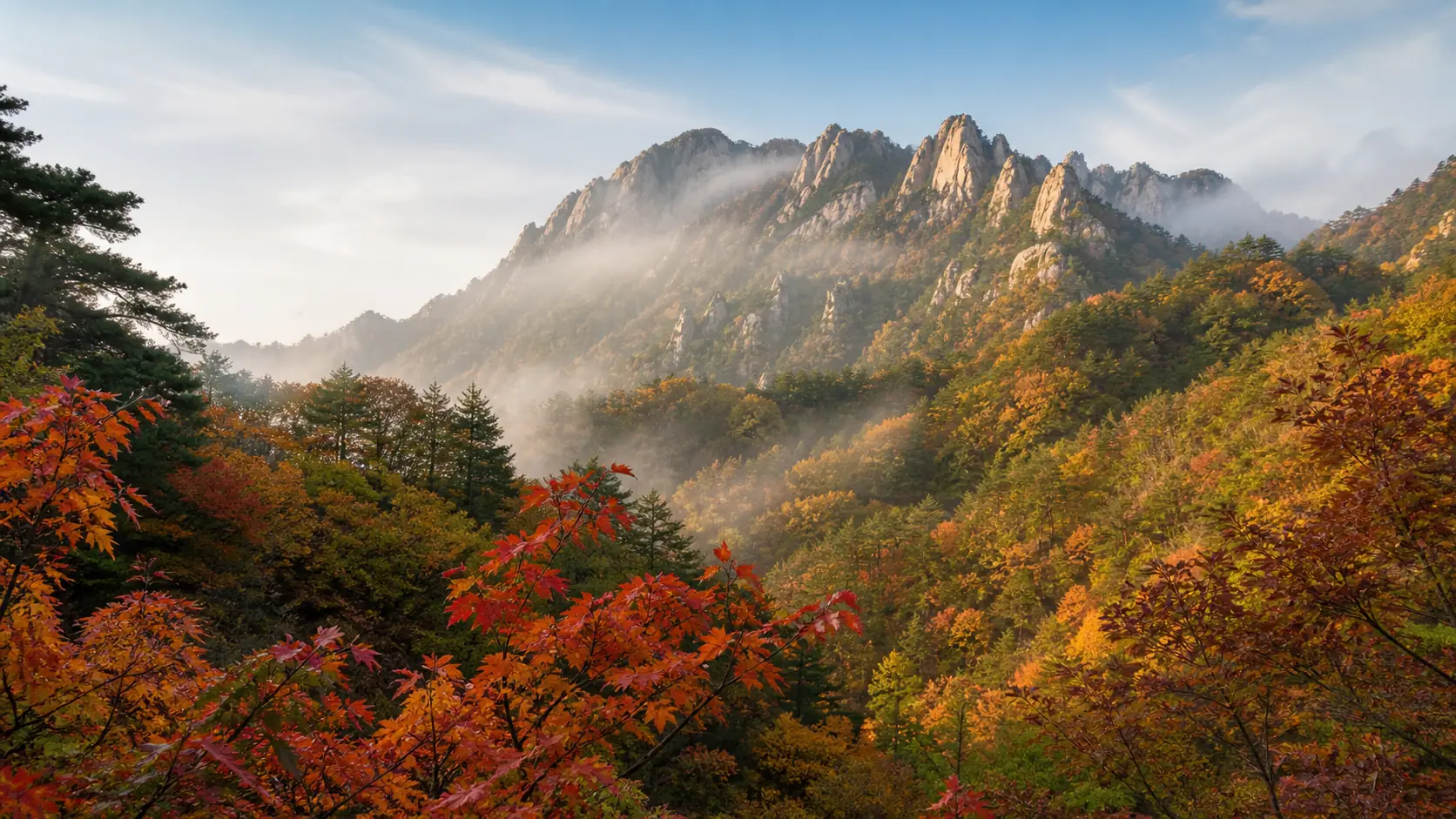
Seoraksan fall foliage 2026 is forecast to reach peak maple color around October 20, with oak color following around October 25, according to the Korea Forest Service's September 22 forecast maps. First foliage was observed on September 28 by the Korea Meteorological Administration (KMA).
For a foliage-focused trip, our planning recommendation is October 17-27, with one night in Sokcho and flexibility to choose your mountain morning. That is a travel window, not a promise that every trail will peak together. Color develops at different times across ridges, temple grounds, and valleys.
Updated October 8, 2026: This guide now includes the published 2026 forecast and observed first foliage. Forecast dates describe expected color; check live trail photos, wind, rain, and park access before setting out.
Seoraksan fall foliage 2026: peak dates at a glance
| Date or decision | What it means |
|---|---|
| September 28, 2026 | First foliage actually observed by KMA |
| October 20, 2026 | Korea Forest Service maple peak forecast |
| October 25, 2026 | Korea Forest Service oak peak forecast |
| October 17 | KMA long-term normal peak, not this year's confirmed date |
| October 29, 2024 / October 24, 2025 | Previous KMA observed peaks, not predictions for 2026 |
| October 17-27 | Our recommended planning window; adjust to route conditions |
| A weekday, with an early start | Our recommendation for reducing traffic and queue risk |
The forecast and observation use different definitions: the Forest Service maps mark at least 50% coloring for each tree group; KMA records a mountain-wide peak at roughly 80%. Do not read the October 20 forecast as an already observed peak, or compare it directly with KMA's historical dates.
For wider seasonal context, see our Seoraksan weather-by-season guide and best time to visit Sokcho.
What is the latest official Seoraksan foliage update?
The 2026 forecast has been published. The Forest Service released its species maps on September 22; KMA confirmed first foliage six days later. Use the published forecast for planning and dated observations for the stage already reached.
The confirmed first-color date is a useful correction to the idea that every recent autumn must run late: it matched the long-term normal and came four days before the 2025 first-color observation. It does not, by itself, determine when your chosen trail will look its best.
For current conditions, open KMA's mountain foliage observations and select 설악산 (Seoraksan). The Gangwon foliage and weather service also provides trail imagery and weather information. Check the image date: a photo of first foliage is a dated observation, not necessarily today's view.
A forecast helps you choose travel dates. Recent images help you choose between a ridge panorama and a valley walk. Neither replaces the park's access notices or the next day's mountain weather.
Korea fall foliage forecast 2026: other mountains
If your trip includes more than Seoraksan, use the Korea Forest Service's 2026 maps to compare regions. The mountain dates below are maple forecasts; the national rows are species averages, not dates for every park or city.
| Mountain or tree group | Forecast peak |
|---|---|
| Seoraksan maples (Gangwon, near Sokcho) | October 20 |
| Seoraksan oaks | October 25 |
| Songnisan maples (central Korea) | October 28 |
| Naejangsan maples (southwest) | November 4 |
| Hallasan maples, 1100 Road area (Jeju) | November 6 |
| Ginkgo, national average | October 30 |
| Maples and oaks, national averages | October 31 |
The north-to-south progression can help you sequence a multi-stop trip. For Seoul's streets and parks, check local observations rather than treating a national average as a city forecast. Trees, elevation, and exposure can put neighboring places at different stages.
What do “first foliage” and “peak foliage” actually mean?
KMA uses a visual threshold for the whole mountain, distinct from the Forest Service species maps:
- First foliage means about 20% of the mountain is colored when viewed from the summit downward.
- Peak foliage means about 80% is colored.
Peak often comes around 20 days after first foliage, but that is a rule of thumb, not a timer. In 2024, Seoraksan moved from first color on October 4 to peak on October 29. In 2025, it moved from October 2 to October 24. Temperature, rain, wind, slope exposure, and elevation all affect what survives between those two official markers.
This is why two travelers can visit on the same day and report completely different conditions. One may be looking across a granite ridge where leaves have already dropped; the other may be walking under brilliant color near the valley floor. Calendar dates are clues. Elevation is the map.
When is the best time to visit Seoraksan for autumn leaves?
Think in route windows rather than one universal peak:
| Your priority | Planning window | Why |
|---|---|---|
| First color on exposed ridges | Early to mid-October | Higher, cooler terrain changes first |
| The broadest mix of elevations | October 17-27 | Our planning recommendation around the published species forecasts |
| Temple grounds and lower valley color | Late October into early November | Autumn moves downhill; lower leaves often last longer |
| Lowest crowd pressure | A Tuesday-Thursday inside your window | Peak-color weekends create the most transport and trail friction |
These route windows are editorial guidance, not trail-specific forecasts. Choose within them using recent photos. Strong wind or heavy rain can strip exposed leaves while sheltered valleys still have color; early November is a possible lower-valley extension, not a dependable mountain-wide peak.
If foliage is the reason for the entire trip, stay one night and two days in Sokcho. Give Seoraksan the clearer morning and keep one backup window. A rushed Seoul day trip can work, but it leaves very little resilience when traffic, wind, or a weather-related cable-car pause enters the equation.
Which Seoraksan route is best at each stage of autumn?
Before the official peak: Ulsanbawi or the cable car
For early color, go higher. Ulsanbawi gives you a long view across exposed granite and forest, with a much bigger physical commitment than its postcard suggests. Read the Seoraksan trail map guide before treating it as a casual viewpoint.
The Seoraksan cable car is the efficient alternative when time or mobility matters. It climbs from Sogongwon toward Gwongeumseong in about five minutes, but it is not a reservation product: the official operator sells tickets only on site, service depends on mountain weather, and autumn demand can absorb a large part of the morning. If this is your non-negotiable view, arrive early and check the operator's notice before leaving Sokcho.
Around the broad peak: Biseondae
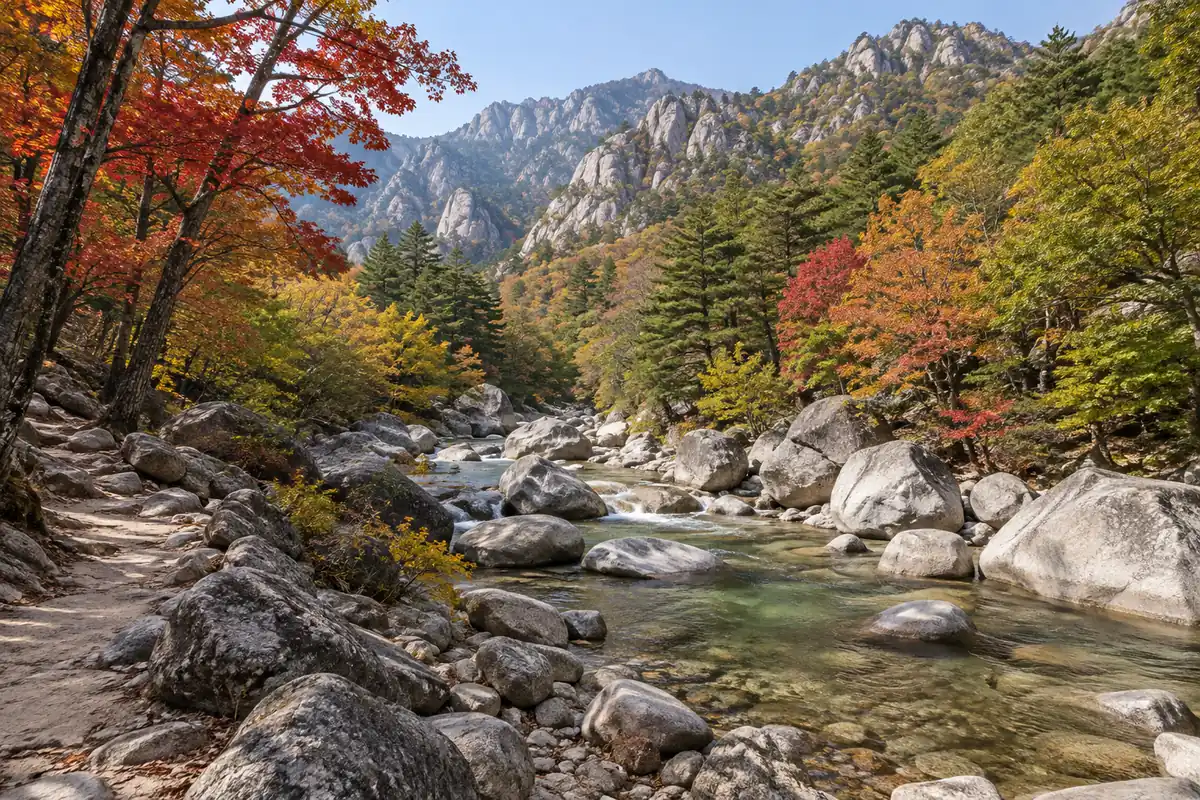
Biseondae is the balanced choice: granite walls, clear water, and enough elevation change to show several stages of autumn in one walk. It is more forgiving than Ulsanbawi and more immersive than a viewpoint-only visit. Our beginner Seoraksan hikes guide explains the route and the point where an easy valley walk becomes a more serious mountain day.
After the upper slopes fade: Sinheungsa, Sogongwon, and the southern valleys
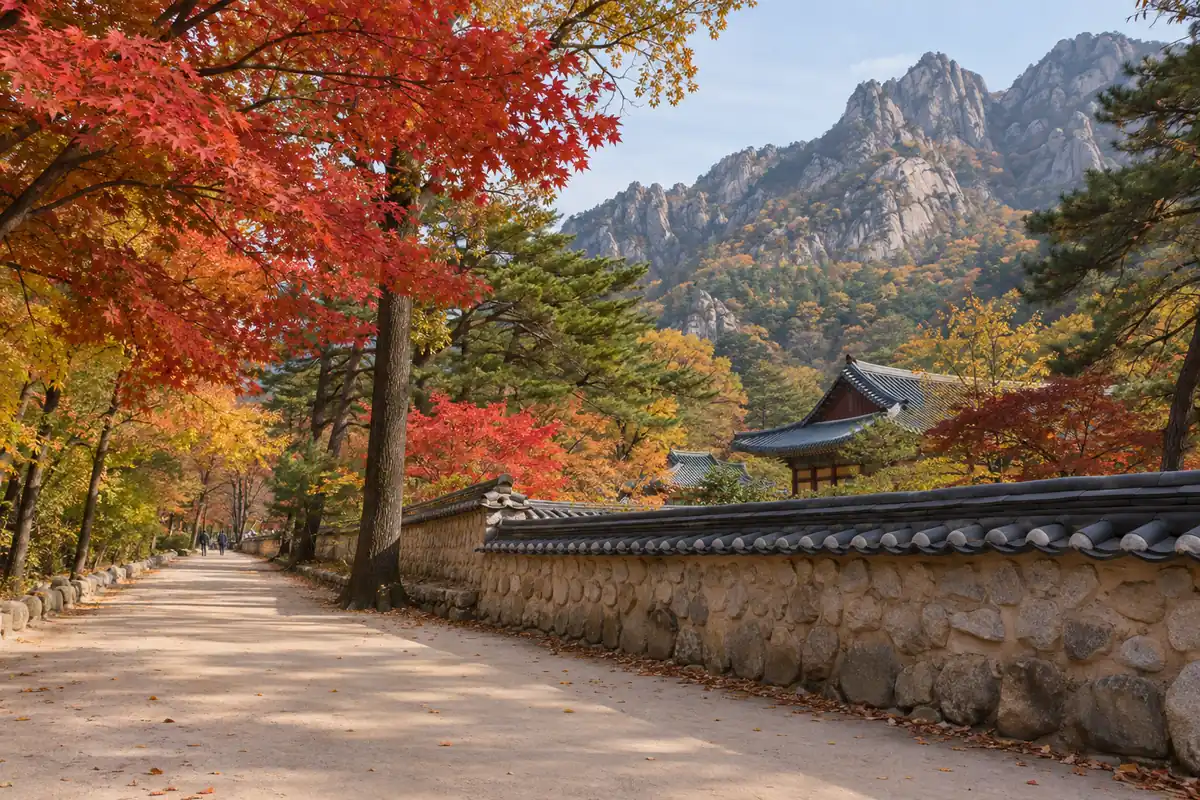
When the highest ridges look thin, do not assume the season is over. The approach through Sogongwon and Sinheungsa can still hold saturated color at a gentler pace. South Seorak's Jujeongol and Heullimgol area is another strong late-season option, but access rules are route-specific. The 2026 Korea National Park Service notice lists Heullimgol reservations from October 1 through November 30 for the 3.1 km section from Heullimgol Visitor Support Center to Yongso junction. It lists October entry hours of 8 a.m.-3 p.m. and a capacity of 5,000 people per day. Check current access notices and book through the official park reservation system before traveling; do not assume neighboring Jujeongol follows the same reservation rules.
November visits: check high-trail closures
Autumn wildfire restrictions can change a November hiking plan even when lower valleys still have color. In the 2025 closure reported by Kyunghyang Shinmun, high routes toward Daecheongbong, including Gongnyong Ridge and the Hangyeryeong approach, closed from November 15 to December 15. Biseondae, Ulsanbawi, the Towangseong Falls viewpoint, and Jujeongol remained open under that year's notice.
Those are 2025 dates and routes, not a confirmed 2026 schedule. We did not find a 2026 autumn closure notice in the sources checked on October 8. Before a November visit, check Seoraksan National Park's official site for the current notice and your exact trail; do not assume last year's open routes will remain open.
How do you avoid the worst fall-foliage crowds?
Peak color is also peak demand. The goal is not to find an empty Seoraksan—it is to remove the avoidable bottlenecks.
- Choose Tuesday through Thursday if you can. Moving one mountain day away from Saturday often matters more than moving it by one foliage date.
- Sleep in Sokcho and start early. You reach the park before the main wave of day-trippers and keep a second morning if weather turns.
- Do not build a tight day around the cable car. Tickets are on-site only and operations are weather-dependent.
- Keep one lower route in reserve. Sinheungsa, Sogongwon, or Biseondae can still deliver when upper leaves or winds disappoint.
- Use public transport when road traffic is the bigger risk. Sokcho buses 7 and 7-1 serve the Seoraksan Sogongwon terminus; our Sokcho-to-Seoraksan bus guide has the stop names, fares, and live-check links.
What should you check the day before your visit?
- Live foliage and mountain weather: KMA Gangwon foliage service
- Trail access and reservations: Korea National Park Service reservation system and current Seoraksan park notices
- Cable-car operation: Seorak Cable Car official website
- Route difficulty: the HeySeorak Seoraksan hub and current park map
- Bus timing: Naver Map or KakaoMap on the morning of travel, using the destination 설악산소공원
Entry to the main Seoraksan park area is free; the cable car and any separate transport still cost extra. Pack a warm layer even if Sokcho feels mild. The mountain can be notably colder and windier than the coast, and conditions change quickly across elevation. Shoes with grip matter after rain, while gloves and a light insulating layer can make an early cable-car or ridge wait much more comfortable.
For monthly temperature and rain context, use Sokcho weather by month. For a trip that can pivot between mountain and coast, the Sokcho travel guide is the better starting point.
Why has Seoraksan's peak foliage been arriving later?
Leaves change as shorter days and cooling temperatures slow chlorophyll production. When late summer and September stay warm, that cooling signal arrives later. The effect is visible in recent Korean climate records: September 2024 averaged 24.7°C nationwide, 4.2°C above the 1991-2020 normal, and Seoraksan's peak followed on October 29—12 days later than its normal date.
The broader direction is not just one unusual season. A peer-reviewed study of 20 deciduous broadleaf species observed at 10 Korean arboreta from 2009 to 2024 found that peak autumn color shifted later by 0.33 days per year on average. That is a nationwide, multi-species phenology result—not a Seoraksan-specific forecast, and its peak definition is different from KMA's 80% mountain observation. It is evidence for the direction of change, not a formula for choosing your 2026 hotel night.
For travelers, the lesson is to keep a range of dates and a choice of elevations. The late peaks in 2024 and 2025 show how far a season can shift; 2026's normal first-color date is a reason to follow this year's observations instead of automatically booking later.
FAQ
When is peak fall foliage at Seoraksan in 2026?
The Korea Forest Service forecasts maple peak color on October 20 and oak peak color on October 25, 2026. These are species forecasts using a 50 percent coloring threshold, not KMA's 80 percent mountain-wide peak observation. Use mid-to-late October for planning and check live conditions before choosing your route.
What is the Korea fall foliage forecast for 2026?
The Korea Forest Service forecasts maple peak color at Seoraksan on October 20, Songnisan on October 28, Naejangsan on November 4, and Hallasan's 1100 Road area on November 6. National species averages are October 30 for ginkgo and October 31 for maples and oaks. These are forecasts at a 50 percent coloring threshold, not observed peak dates.
Is late October a good time for Seoraksan autumn leaves?
Late October is a reasonable choice for lower trails, but color is not guaranteed. In 2026, first foliage was observed on September 28, four days earlier than in 2025. Check recent photos around Biseondae, Sinheungsa, and Sogongwon rather than assuming last year's late peak will repeat.
What do first foliage and peak foliage mean?
KMA marks first foliage when roughly 20 percent of the mountain is colored from the summit downward. Peak foliage means about 80 percent is colored. The Korea Forest Service's species forecast uses a different threshold: at least 50 percent coloring. These dates describe different stages.
Can I reserve the Seoraksan cable car for foliage season?
No. The official operator sells tickets only on site and does not accept advance reservations. Service is weather-dependent, so check the official operating notice and arrive early if the cable car is central to your day.
Can I still see Seoraksan fall foliage in November?
Early November may still offer color on sheltered lower routes, but it is a less reliable choice for a trip centered on foliage. Check recent valley photos and current trail access before committing; upper ridges can be past their best even when lower trees still have leaves.
Can I see Seoraksan fall foliage on a day trip from Seoul?
It is possible, but peak-season traffic and on-site cable-car queues make the schedule fragile. One night in Sokcho gives you an early mountain start, a backup weather window, and a much better chance of avoiding the busiest arrival period.
How many days should I spend in Sokcho for fall foliage?
One night and two days is the practical minimum. Use the clearer day for Seoraksan and keep the other for Sokcho's market, coast, or a second mountain attempt if wind or rain changes the plan.
Sources and methodology
- Korea Forest Service: 2026 species forecast maps, September 22 — maple and oak dates; 50% coloring threshold
- KMA: Seoraksan first foliage observed on September 28, 2026 — observed first color, normal dates, 2025 peak, and 20%/80% definitions
- Kyunghyang Shinmun: 2025 high-trail closure — historical November 15-December 15 restrictions; 2026 access must be checked separately
- KMA: Seoraksan first foliage observed on October 2, 2025 — 2025 first-color observation and the 2024 peak date
- KMA: September 2024 climate report — national temperature anomaly during the late 2024 foliage season
- Long-Term Assessment of Plant Phenology in South Korea, 2009-2024 — nationwide arboretum evidence for later peak autumn color
- Seorak Cable Car official website — ticketing and weather-dependent operating rules
- Korea National Park Service: 2026 Heullimgol reservation notice — reservation dates, trail section, hours, and daily capacity
- Korean government: national-park cultural-property admission fee change — the 2023 removal of the former temple cultural-property viewing fee
Dates above distinguish a published forecast, a recorded observation, and our travel recommendations. The climate study uses 90-100% coloring across arboretum species, a third definition of peak. We checked the linked sources on October 8, 2026; this article does not claim a same-day field inspection. The hero illustration does not show current foliage conditions.
If you already know your dates, start a HeySeorak plan. Tell us whether you want the cable car, a real hike, or the gentlest possible color walk, and we will match the day to the right elevation.