The story
The founder grew up in Daegu, studied music composition in Seoul, and added a second major in cultural arts content before joining KOICA in December 2019 as an overseas volunteer bound for Rwanda. Three months in, COVID sent her home. In 2020 she landed in Sokcho — a city she had never planned on — and stayed. A detour through international development (ODA) led her to global-citizenship environmental education, and in 2021 she founded 쓰담속초 (Ssadam Sokcho), a volunteer group that combs the coast's overlooked beaches for trash. In August 2022 she launched 빛나르고 (Bitnarego) — a company whose name means 'carrying the light of change' — turning down a second Rwanda deployment to plant herself in Sokcho instead. In 2023 a local-creator grant funded the first remodel of this building; in early 2025 it reopened as an unmanned edit shop. TMM Market is where five years of that work condensed into a single room.
“소외되었던 것들이 새롭게 발견되고, 기록되고, 만들어지는 공간 — a place where the overlooked things get discovered, recorded, and remade. That's what TMM means to me.”
Owner, TMM Market
What they stand for
'Teum' is the Korean word for a gap or a crack — the overlooked spaces in between. TMM stands for both 'Things Make Miracles' and '틈에서 시작된 기적' (miracles that start in the cracks), and the shelves work to three criteria: zero waste, upcycled, or fair trade. The logo is pixelated on purpose — small Things, assembled, making something bigger. Ocean stories, overlooked neighborhoods, women's collectives overseas: everything the shop sells or shows is an argument that the things most people walk past are the material for something worth looking at.
Behind the signature
Two in-house pieces anchor the store. The first is a keychain made from sea glass — bottle shards the ocean has tumbled smooth over years, picked up off Sokcho's beaches. It's the souvenir most tourists leave with. The second is the Wave Phone Stand, the shop's very first self-designed product and a steady bestseller: Sokcho residents collected bottle caps, the team shredded and melted them, and the recycled plastic was injection-molded into phone stands engraved with a wave pattern that nods to the coast just down the street. Elsewhere on the shelves: bags and cardholders upcycled from retired city-festival banners, postcards printed with three pieces of ocean trash each, fair-trade keychains from a women's collective in Nepal, elephant-dung notebooks, and fabric-scrap wallets from a local Sokcho work-integration center.
Local tip
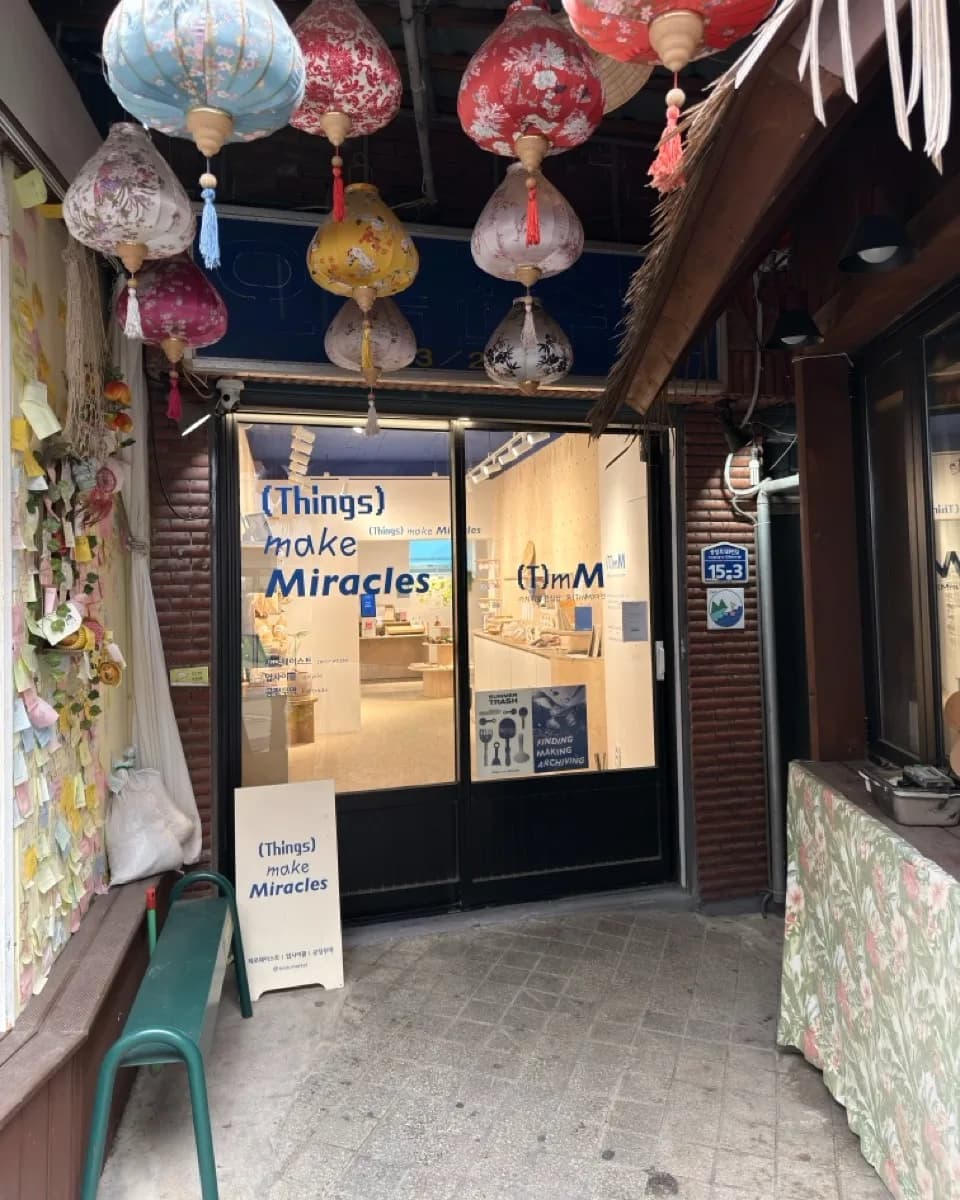
The shop is a short walk from Sokcho's Tourist & Fishery Market, tucked into 중앙로129번길 — a numbered side alley off the main Jungang-ro road. The owner's own directions are still the best way to find it: 'across from 코끼리분식 (Elephant Snacks), in the gap between 조하눅패션 (Zohanook Fashion) and 비엔망 — literally in the teum, the crack between two other shops.' That's not a metaphor — the shop is named for the space it physically sits in. Look for the pixelated logo. It's an unmanned room, open year-round: browse freely, read the product cards, pay on your own (지역화폐, 제로페이, and tap-to-pay all work), and make sure you walk to the back wall where the ocean plastic the team has been collecting since 2021 is archived in full view next to the small shredding and melting machines they use to remake it.
Seasonal note
What sits on the shelves rotates with the beach cleanups and the city's events. Sea glass supply ebbs and flows with the tides; festival-banner upcycling waits on whichever Sokcho event has just wrapped. If something on the shelf looks brand new, it probably is — ask what's behind it.
For travelers
You don't need to buy anything. The owner's hope is that visitors wander in and look — at the trash wall, at the small melting and shredding machines, at the evidence of what a tiny brand in a small coastal city is actually doing. English product descriptions are being added this year. In the meantime, the sea glass keychain and the Wave Phone Stand are the two objects with the clearest Sokcho origin story: one pulled from the water, one made from the bottle caps of the city around you.